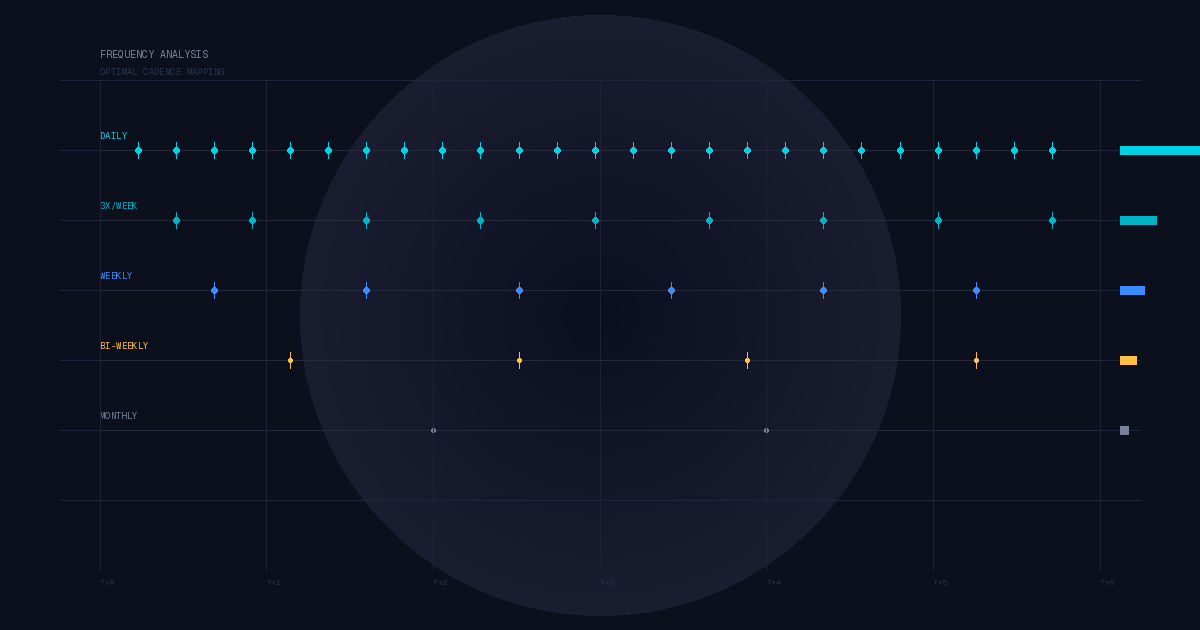
"How often should I post?" is the wrong question. The right question is "how consistently can I show up?" — because the data overwhelmingly shows that any regular posting beats sporadic brilliance. You could write the most viral-worthy post ever, but if it's your only post all month, nobody sees it. The algorithm doesn't care how good your content is if you're not feeding the feed consistently.
The Short Answer (By Platform)
Let's get the numbers out of the way upfront, because this is the part everyone actually wants to know. According to HeyOrca's 2026 research, Facebook performs best at 1-2 posts per day. Instagram needs at least 3-5 posts per week to stay competitive in the algorithm. LinkedIn sits somewhere in the middle at 2-5 posts per week, depending on your industry and audience. And Google Business Profile, which most businesses treat like a forgotten cousin, actually boosts your local search visibility with regular posting — even just weekly will make a difference.
Now here's the part that hits different when you actually run the numbers: most businesses post 8-12 times per month total across all platforms. That's not per platform. That's everything combined. So if you've got Facebook, Instagram, LinkedIn, and a Google Business Profile, you're averaging maybe 2-3 posts per platform per month. Compare that to what the data says you should be doing, and suddenly you're looking at a 10x gap.
Why Frequency Matters More Than You Think
There's this persistent myth in business that quality always beats quantity. It's comforting to believe, because it means you don't have to work as hard. You can spend three weeks perfecting one post and hope it goes viral. Except that's not how social media algorithms work in 2026, and the data backs this up pretty clearly.
Buffer analyzed over 52 million social media posts and found something that should honestly change how you think about posting. Accounts that skipped posting in a given week consistently underperformed their baseline metrics the following week. Not just slightly. Noticeably. The algorithm sees consistency as a signal of health and legitimacy. It's not personal — it's just how the system works. The platform wants to keep users engaged, so it rewards accounts that show up regularly. If you post three times and then go silent for two weeks, the platform's algorithm essentially forgets about you. You're starting from scratch when you post again.
Think of it like a friendship. If you reach out to someone regularly, they stay engaged in your life. If you disappear for a month and then send a random message, there's friction. Social media platforms work the same way with your audience.
Accounts that skipped posting in a given week consistently underperformed their baseline metrics the following week.
The Engagement Reality Check
Let's talk about actual engagement numbers, because they're probably depressing. Buffer's data shows Instagram averages 0.48% engagement, Facebook sits at around 0.15%, and TikTok is the outlier at 3.70%. Those percentages might not sound bad until you do the math. If you have 10,000 followers on Instagram and post once, you're reaching maybe 48 people in an engaged way. Post once a week and you're looking at maybe 240 people per month. Post five times a week and you're pushing that closer to 1,200 engaged people.
The point here isn't to get depressed about low engagement rates. The point is that volume is the only way to fight algorithmic suppression. You can't count on a single post to carry your social strategy. You need multiple shots on goal. You need frequency.
When to Post (and Why It Matters Less Than You Think)
Sprout Social's research shows that Tuesdays through Thursdays, between 11am and 5pm, generally see the highest engagement across most platforms. If you can time your posts around those windows, great. But here's the thing that matters way more: posting at the "wrong" time is infinitely better than not posting at all.
I've seen businesses obsess over posting at exactly 2:47pm on a Wednesday because that's what some random article said was optimal, while they totally neglect to post on Monday or Friday. That's backwards. Post when you can, consistently, and you'll outperform the business that posts once a week at exactly the "right" time. The algorithm rewards consistency, not perfection.
The Gap Between Optimal and Reality
Let's do some math that probably makes you uncomfortable. Say you have four platforms: Facebook, Instagram, LinkedIn, and Google Business Profile. The research says you should be posting 1-2 times daily on Facebook (let's say 10 per week), 3-5 times per week on Instagram (let's say 4 per week), 2-5 times per week on LinkedIn (let's say 3 per week), and at least once weekly on Google Business Profile. That's roughly 18 posts per week, or about 72 posts per month across four platforms.
But you could argue for being more conservative. Maybe you're not a daily business. Maybe 5 posts per week per platform is your ceiling. That's still roughly 20 posts per week, or 80 per month. Even if you cut it in half and say 40 posts per month across four platforms, you're still looking at 10 per platform monthly. And the average business is doing 8-12 posts per month total. That's the gap.
No wonder social media "doesn't work" for most businesses. They're not doing enough of it. It's like wondering why you're not fit when you exercise once a month. The system requires consistency to work, and most businesses aren't consistent with social media because they're treating it like a side project instead of a core marketing channel.
How to Actually Hit These Numbers
Here's where most small business owners check out, because the number sounds impossible. How are you supposed to write 80+ posts per month when you're already running the business? The answer is you don't do it manually, and you don't do it alone.
Batch content creation is your first move. Instead of writing one post and pushing it out, spend a few hours once a month creating 20-30 pieces of content all at once. It's way more efficient than context-switching every day. Use templates and frameworks so you're not reinventing the wheel each time.
Repurposing is your second move. One blog post becomes five social posts. One customer testimonial becomes three variations. One team photo becomes five different captions and angles. You're not creating new content from scratch every time — you're finding different angles on the same material.
AI tools are your third move. Whether it's ChatGPT helping you generate post variations, a scheduling tool that handles distribution, or an AI-powered writing assistant that handles the first draft, there's no shame in using tools to hit the frequency you need. The businesses that complain about not having time for social are usually the same ones doing everything manually.
And finally, if it's still not feasible in-house, hire it out. This is what services like Maximus exist for — to create the 80-120 posts per month that your business needs to actually compete on social media. It's not a luxury. It's the price of admission in 2026.
The Bottom Line
Posting frequency matters because algorithms reward consistency, because volume fights algorithmic suppression, and because most of your audience will never see a single post anyway. The "optimal" frequency might seem overwhelming — 100+ posts per month across four platforms — but that's only overwhelming if you're thinking about doing it manually. The businesses that are winning on social in 2026 aren't necessarily writing better posts than their competitors. They're just showing up more often. Be the business that shows up. That's the real competitive advantage.