Every small business owner I talk to right now falls into one of two camps. Camp one is terrified of AI and won't touch it. Camp two has gone all-in, handing every single piece of content to a chatbot and hitting publish without a second thought.
Both camps are losing. The businesses that are actually winning at content right now? They've figured out the split. They know which parts of the content machine to automate and which parts still need a human behind the wheel.
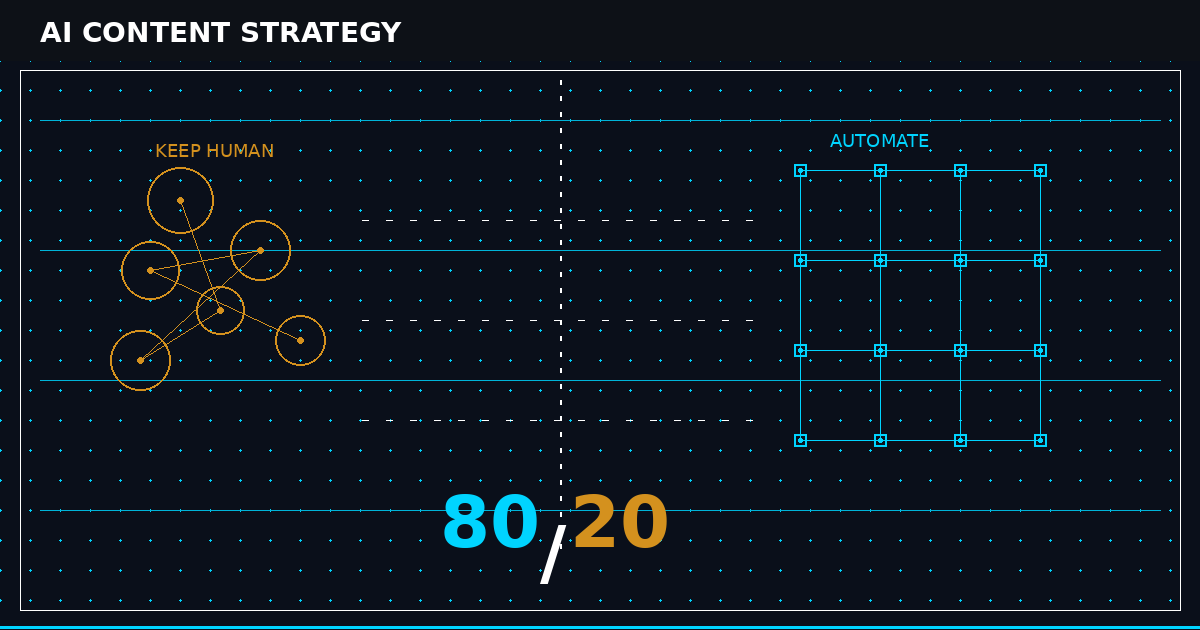
This is the 80/20 rule of AI content — and if you get it right, you'll produce more, publish faster, and still sound like you.
Why the "All or Nothing" Approach Fails
Here's the uncomfortable truth: pure AI content is getting easier to spot by the day. Your audience might not be able to articulate why a post feels off, but they notice. It reads clean. It reads correct. And it reads like it was written by absolutely nobody.
On the flip side, doing everything manually in 2026 is like insisting on hand-washing your clothes when you own a washing machine. You're not more authentic — you're just slower. Your competitors are publishing five posts for every one of yours, and their content is getting better because they're spending their human energy where it actually matters.
The goal isn't to replace yourself with AI. It's to stop wasting your expertise on tasks that don't need it.
The 80%: What AI Should Handle
These are the repetitive, structural, time-consuming tasks that eat up your week without adding much of your personal expertise. Hand them over without guilt:
First Drafts and Outlines
AI is exceptional at going from a topic to a structured draft in minutes. You shouldn't be staring at a blank page anymore. Give AI your topic, your target audience, and a few bullet points you want to hit. Let it build the skeleton. You'll spend your time rewriting and adding voice — not figuring out paragraph order.
Social Media Variations
You wrote one great blog post. Now you need a LinkedIn summary, three Instagram captions, a Facebook post, and two tweets. AI can generate all of those variations in seconds. This is pure format translation — the kind of work that used to take an hour and now takes two minutes.
SEO Metadata and Descriptions
Meta descriptions, title tags, alt text, keyword variations — this is mechanical work. AI handles it well because there's a clear formula. Feed it your content and let it generate optimized metadata. If you want to learn more about why this matters, check out our local SEO guide.
Content Repurposing
Turning a blog post into an email newsletter intro, a script outline for a short video, or a series of quote graphics — all of this is restructuring existing ideas. AI does it quickly and consistently.
Research Summaries and Data Points
Need stats to support a point? Need a quick overview of a topic before you write about it? AI can compile background research faster than you can open ten browser tabs. Just make sure you verify anything you plan to publish.
The 20%: What Stays Human
This is where it falls apart for businesses that over-automate. These tasks are where your brand lives or dies — and no AI can do them for you. Not yet.
Your Actual Opinions
AI doesn't have opinions. It has averages. When you take a strong stance on something in your industry — when you say "this trend is garbage and here's why" — that's magnetic. That's what builds an audience. Every piece of content needs at least one moment where you show up with a perspective that couldn't have come from anyone else.
Stories From Your Business
The client who came in skeptical and left amazed. The mistake you made in year one that shaped how you operate today. The weird thing that happened last Tuesday. These stories are irreplaceable. AI can help you structure them, but it can't invent them. If you're not injecting real stories into your content, you're already sounding like a template.
Voice and Final Editing
Read the AI draft out loud. Does it sound like you talking to a customer? Probably not on the first pass. The final edit — where you cut the corporate fluff, add your rhythm, swap in the phrases your customers actually use — that's the 20% that makes the other 80% worth publishing.
Strategy and Topic Selection
Which topics matter to your audience right now? What's the angle that no one else is covering? What content connects back to your actual business goals? These decisions require judgment, industry knowledge, and an understanding of your specific customer that AI simply doesn't have.
How to Apply This Today
- Audit your current workflow. Write down every step between "idea" and "published post." Mark each step as either "requires my expertise" or "requires my time but not my brain."
- Automate the time-heavy steps first. Start with first drafts and social variations. These give you the biggest time savings with the lowest risk.
- Build a voice guide. Document your tone, phrases you use, phrases you'd never use, and examples of your best past content. Use this to train your AI tools — and to check their output against.
- Set a "human checkpoint." No content goes live without a human pass. Period. Even if it's a five-minute review, that checkpoint is what separates professional content from AI slop.
- Track what performs. Compare engagement on AI-assisted posts versus fully manual ones. You'll likely find the hybrid approach outperforms both — more volume than manual, more authenticity than pure AI.
Common Mistakes to Avoid
- Publishing AI drafts without editing. The first draft is never the final product. Treat AI output like a rough draft from an intern — useful, but not ready for your audience.
- Automating your opinions. If AI wrote your "hot take," it's not hot. It's lukewarm at best. Your perspective is your competitive advantage. Don't outsource it.
- Ignoring your analytics. If your AI-heavy posts are getting less engagement, that's data. Adjust the split. Maybe your audience needs more human in the mix — or maybe you need to tighten your prompts.
- Using the same AI tool for everything. Different tools have different strengths. The tool that writes great blog drafts might be terrible at social captions. Experiment.
- Skipping the voice guide. Without documented standards, every AI draft starts from zero. A voice guide compounds your results over time.
The Bottom Line
AI isn't replacing your content strategy. It's replacing the busywork around your content strategy. The businesses that figure out the split — 80% automation on the structural work, 20% human energy on voice, stories, and strategy — are the ones publishing consistently without burning out.
You don't need to choose between quality and quantity anymore. You need to choose where to spend your attention. Put it where only you can make a difference, and let the machines handle the rest.