Here's the uncomfortable truth: most small businesses pour money into chasing strangers and barely spend a dollar on the customers they already have.
You've seen the playbook. Boost the post. Run the Google ad. Hand out the flyer. Onboard the new lead. Repeat. Meanwhile, the customer who bought from you six months ago — the one who already knows you, trusts you, and would absolutely buy again — gets nothing. No follow-up. No check-in. No reason to come back.
That's not a marketing strategy. That's a leaky bucket. And the math behind it is brutal.
The Retention Math (And Why It Should Terrify You)
Let me lay out the numbers that should be hanging on every small business owner's wall:
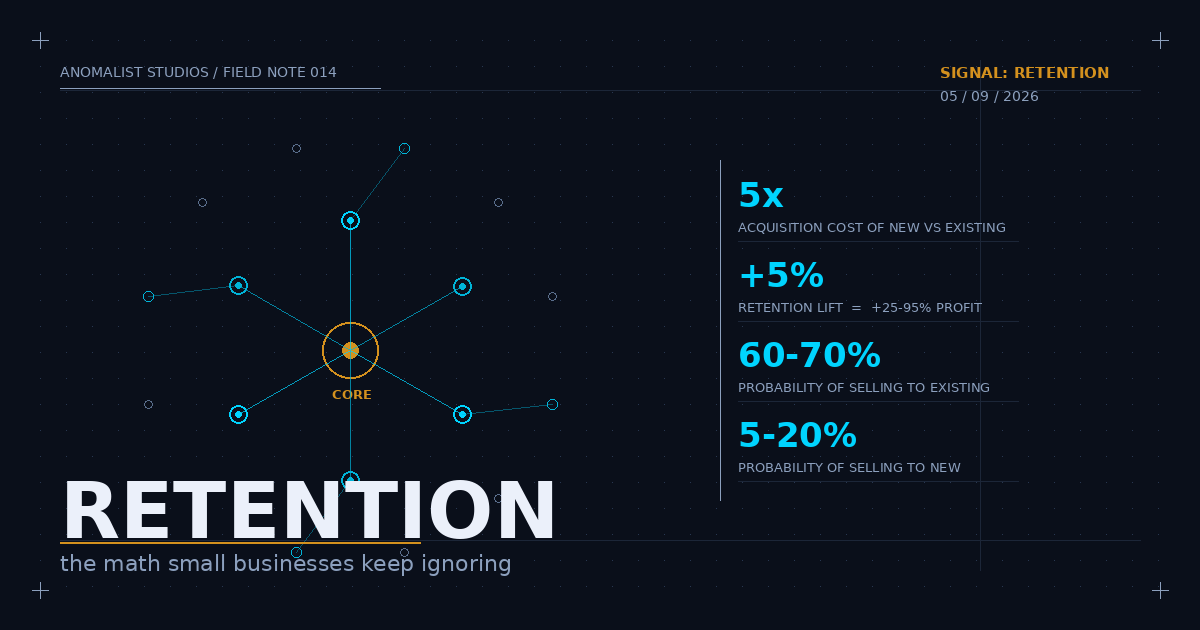
- Acquiring a new customer costs roughly 5x more than retaining an existing one. That's been backed by Bain & Company, Harvard Business Review, and basically every customer-loyalty study published in the last twenty years.
- A 5% increase in retention can lift profits anywhere from 25% to 95%. Same Bain research. The reason is simple: existing customers buy more often, spend more per visit, and refer others without you paying for the ad.
- You're 60–70% likely to sell to an existing customer. You're 5–20% likely to sell to a new one. That stat comes from Marketing Metrics, and once it lodges in your brain, it changes how you think about every dollar you spend.
So why do most small businesses still spend 80% of their marketing budget on acquisition? Because new customers are visible. Retention is invisible. You don't see the customer who quietly stops coming back — you only see the empty seat, the slow Tuesday, the unexplained dip in revenue. And by then, it's too late.
Why Retention Quietly Falls Off the To-Do List
I'll tell you the real reason. Retention is boring. It's not a launch. It's not a campaign. It's not something you can post about on Instagram and feel proud of. It's a slow, unglamorous habit of staying in front of people who've already paid you.
And it's invisible from the outside. Nobody walks into your shop and says, "Wow, your retention email sequence is fantastic." Customers don't notice the system. They just notice that you remembered them.
That's the trap. Acquisition gets the budget because it gets the credit. Retention gets ignored because it works in the background. But the businesses that quietly dominate their local market — the dentist with a six-month wait list, the gym with a 90% renewal rate, the restaurant that's full on a Wednesday — every single one of them is winning at retention. They just aren't bragging about it.
What Retention Actually Looks Like for a Small Business
Forget enterprise CRM dashboards and loyalty point systems built for chains. For most local businesses, retention is much simpler than the SaaS world makes it sound. It comes down to four things:
1. They Hear From You Between Purchases
If a customer only hears from you when you want their money, you have a transactional relationship. Email newsletters, social media follow-up, a quick text after service — anything that says "we're still here, still thinking about you" — keeps you in mental real estate. Posting consistently on social is part of this, but only part.
2. The Second Visit Is Engineered, Not Hoped For
The gap between purchase one and purchase two is the most fragile moment in any customer relationship. If nothing pulls them back, momentum dies. Smart small businesses set up a specific trigger — a thank-you offer, a follow-up message, a review request — that turns first-time buyers into second-time buyers on purpose, not by accident.
3. They Track Who's Slipping
You don't need fancy software. You need a list. Who hasn't been in for 60 days? 90 days? Six months? If you don't know, you can't act. The simplest spreadsheet beats the most expensive tool you never open.
4. They Make It Easy to Come Back
Friction kills retention. Confusing booking systems, slow responses, awkward checkout — every speed bump is a chance for the customer to drift to a competitor. Audit your own customer journey. Pretend you're a new customer trying to rebook. Time it. Fix what hurts.
Five Retention Plays You Can Run This Month
Here's the actionable list. Don't try all five at once. Pick one, run it for 30 days, then add the next.
- Build the "lapsed customer" list. Pull every customer who hasn't bought in 60+ days. That's your warmest possible lead pool. Send them a single, personal-feeling email or text with a reason to come back. No discount needed if the relationship is strong — but a small one helps.
- Add a "second visit" trigger. Whatever your business is, define what should happen 7–14 days after a first purchase. A thank-you note. A "how was it?" check-in. A reminder of a complementary service. Automate it once, benefit forever.
- Make a 12-message retention drip for new customers. One message a month for a year. Tips, stories, behind-the-scenes content, the occasional offer. By month 12 you're a habit, not a vendor.
- Ask for the review at the moment of peak happiness. Not a week later. Not after the receipt is forgotten. Right when they're smiling. Reviews aren't just SEO — they reinforce the customer's own decision and make them more likely to come back.
- Personalize one touchpoint a week. One handwritten note. One personal text. One "saw this and thought of you." It's not scalable. That's the point. Customers remember the things that don't feel automated.
Common Retention Mistakes That Quietly Burn Money
Avoid these. They're the patterns I see kill small business retention more than anything else:
- Treating every customer the same. Your top 20% of customers should be getting noticeably different treatment than your one-time buyers. If they aren't, you're under-investing in the people funding your business.
- Discounting your way to loyalty. If the only reason a customer comes back is the coupon, they're loyal to the discount, not to you. Use offers strategically, not as a crutch.
- Going dark for months, then begging for sales. If your only emails are "BUY NOW" emails, your unsubscribe rate will tell you exactly what your customers think.
- Assuming "no complaints" means "they're happy." Most unhappy customers don't complain. They just leave quietly. You have to ask.
- Confusing social media followers with customers. They're not the same thing. A buying customer is worth a hundred passive followers. Build systems that talk to buyers directly, not just an audience. (More on the difference in social media ROI for local businesses.)
The Bottom Line
Acquisition gets the spotlight, but retention pays the bills. The small businesses that grow steadily — without burning through ad budget every month — are the ones that treat the customer relationship as the product. The transaction is just one moment in it.
Cut through the noise: stop spending all your time chasing people who've never heard of you. Start spending half of it on the people who already gave you their money once. The math isn't close.
The bottom line: The cheapest customer to acquire is the one you already have. Retention isn't the boring half of marketing — it's the half that compounds. Build it now, and your future Tuesdays look very different.