You sit down to write a post. You stare at the screen. Forty minutes later you've got a half-baked quote graphic and a caption that starts with "Happy Monday!" You post it, delete it, post a different one, then close the app and tell yourself you'll batch everything Sunday night. You won't.
Here's the uncomfortable truth: the "what do I post?" problem isn't a creativity problem. It's a systems problem. And no amount of inspiration is going to solve a systems problem. You need a framework — something that tells you what to write before you open the app, so your brain stops burning calories on the wrong decision.
That framework is content pillars. Five buckets. A rotation you can run for the rest of the year without ever running out of ideas. Done right, it turns social media from a daily scramble into a weekly planning meeting with yourself that takes twenty minutes.
Why "What Should I Post?" Is The Wrong Question
Every time you sit down and ask yourself "what should I post today?" you're starting from zero. You're a chef who walks into the kitchen with no menu, no prep, no recipe cards. Of course it takes forever. Of course it's inconsistent. Of course half of what comes out is garbage.
The businesses that post consistently — the ones whose feeds don't go dark for two weeks every time things get busy — don't have more discipline than you. They have fewer decisions. They've already decided what kinds of posts they make. They've already decided how often each kind shows up. On any given day, the question isn't "what do I post?" It's "what's next in the rotation, and what example of it am I running this week?"
That's the mental shift. You're not making posts. You're feeding a system. And systems are built out of pillars.
What Content Pillars Actually Are
A content pillar is a category of post that reliably serves one purpose for your audience. That's it. It's not a topic. It's not a hashtag. It's not "fitness content" or "real estate content." Those are industries, not pillars.
A good pillar answers a specific question: What does this post do for the person reading it? Educate them. Build their trust. Remind them you're human. Move them toward a purchase. Each pillar has a job. When every post has a job, nothing feels random.
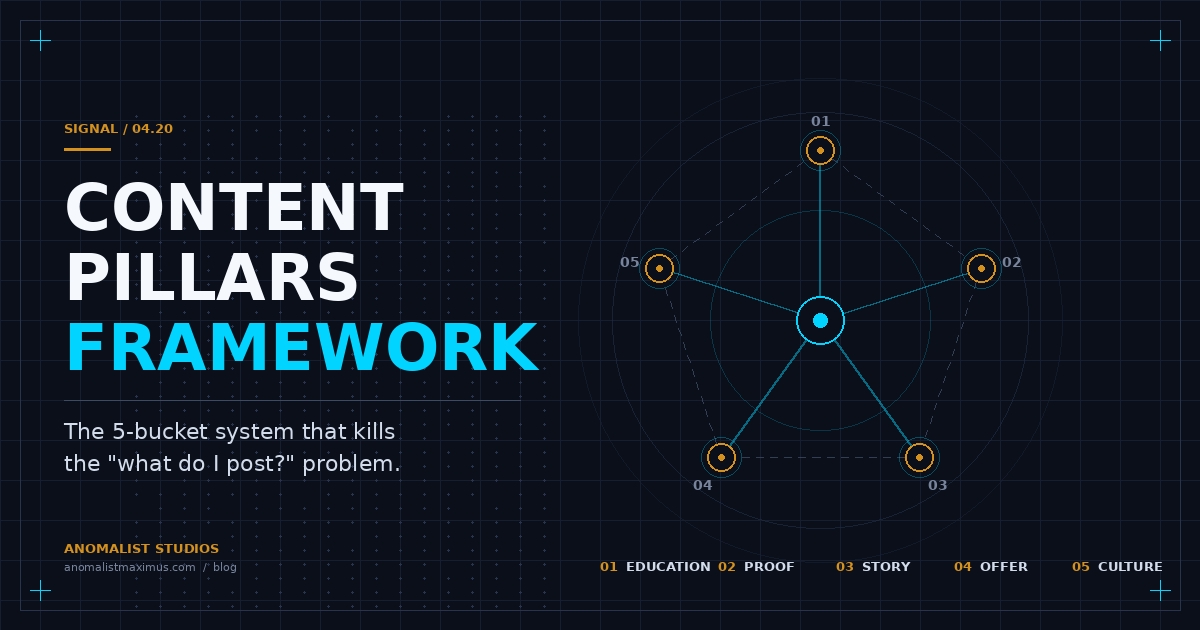
The framework I'm about to walk you through uses five. Five is a deliberate number. Three is too narrow — you'll repeat yourself and the feed gets flat. Seven starts to blur together, and you'll quietly stop using two of them by month two. Five gives you enough variety to keep the feed interesting and enough constraint to actually plan around.
"Content pillars aren't creative limits. They're creative fuel. You stop wasting energy deciding what kind of post to make, and you spend that energy making the post better."
The 5 Pillars, Defined
Here are the five. Names vary across marketing circles, but the functions are consistent. These are the ones that actually work for small businesses posting on Facebook, Instagram, LinkedIn, and Google Business Profile.
Pillar 1: Education
Teach your audience something useful. Tips, how-tos, myth-busters, industry insights, quick explanations of a term they keep seeing. This is your most-searched-for pillar because it answers real questions your audience is typing into Google and TikTok right now.
Examples: "3 things to check before you renew your homeowners policy." "Why your dog pulls on walks (and the one fix most trainers skip)." "The difference between a HELOC and a home equity loan, in 60 seconds."
Education posts build authority. They make you the person who actually knows things, not just the person who wants to sell things. Target: roughly 30-40% of your feed. It's your largest bucket and the one that drives the most saves and shares.
Pillar 2: Proof
Show the work. Client results, testimonials, before-and-afters, case studies, reviews, user-generated content. Proof is what turns a curious follower into someone ready to email you. It answers the unspoken question every prospect has: does this actually work for people like me?
If you don't have testimonials yet, this is where you ask for them. Screenshots of text messages (with permission), Google reviews, photos from happy customers — all of it qualifies. The key is specificity. "Great service!" is noise. "Got me out of a three-year tax mess in six weeks" is proof.
Target: 15-20% of your feed. It's a smaller bucket, but it's the one that actually closes sales when someone is already considering you.
Pillar 3: Story
Tell the story behind the business. Origin, lessons learned, mistakes you made, why you care about this work in the first place. Story is what makes people feel like they know you — and people buy from people they feel like they know.
This is the pillar most business owners resist, because it feels self-indulgent. It isn't. Your audience wants to see the human side. They want the moment you quit your corporate job, the first client who trusted you before you had a website, the time a deal fell through and what it taught you. Story creates emotional bandwidth — the reservoir of trust you draw on when you make an ask.
Target: 15-20% of your feed. Less if you're B2B and more selective in how you share, more if you're a personal brand.
Pillar 4: Offer
Ask for the sale. Directly. This is the pillar most small business owners either overdo or underdo — there's rarely a middle ground. Overdoing it burns out your audience. Underdoing it means people don't know what you do or how to hire you.
Offer posts include: service announcements, limited-time promotions, seasonal availability, new product launches, booking reminders, "here's exactly how to work with me" walkthroughs. Clear, specific, with a call to action that tells people what to do next.
Target: 10-15% of your feed. Lean on the lower end if your other pillars are strong — the education, proof, and story posts do the selling for you.
Pillar 5: Culture
The human fingerprint. Behind-the-scenes, team moments, opinions, reactions to industry news, holiday acknowledgments, things you find funny, what you're reading or watching. Culture is your personality in the feed. It's the pillar that makes your account feel alive instead of automated.
Culture is where your brand voice becomes most visible, which is why it matters that your voice is actually yours. If you want more on that, we wrote a whole post on sounding like yourself even when AI is helping you write. Voice and culture are the same muscle.
Target: 15-20% of your feed. This is the pillar that makes people stick around between offers.
Why Five Pillars Beats "Just Posting Stuff"
Let's do some math. Let's say you're posting five times a week across your primary platform — which is roughly what the algorithms reward in 2026. That's 20 posts a month. Without a framework, those 20 posts cluster. You end up with fourteen educational tips, three random memes, two selfies, one desperate promo at the end of the month, and zero testimonials.
The feed feels lopsided because it is lopsided. And the algorithm notices too — feeds that show a narrow pattern get categorized narrowly, which shrinks the audience you reach over time.
With five pillars and the rough percentages above, those same 20 monthly posts break down cleanly: 7 education, 4 proof, 3 story, 3 offer, 3 culture. Suddenly your feed looks like a business instead of a hobby. More importantly, it serves your audience across the whole buying journey — from "who is this?" to "I'm ready to hire you."
This is also why businesses with pillars don't burn out on content. Variety is a form of rest. When you batch four education posts one afternoon and three culture posts another, your brain isn't context-switching between emotional registers every day. You show up as a teacher, then as a storyteller, then as a closer. Clean lanes.
How To Build Your Pillar System In One Afternoon
Enough theory. Here's the actual build.
- Block 90 minutes. No interruptions. You can't do this between calls. Put it on the calendar like it's a client meeting.
- Write your five pillars at the top of a doc. Use the defaults above or adjust names to fit your industry. A financial planner might rename "Offer" to "Services." A tactical trainer might rename "Proof" to "Range Results." The functions stay the same; the labels serve your voice.
- Assign percentages to each pillar. Start with 35/20/15/15/15. Tune based on your business stage. New business? More education and story (build authority). Established business with bookings to fill? More proof and offer (drive revenue).
- Brainstorm 10 topics per pillar. That's 50 topics. It sounds like a lot; it takes 30 minutes. You're not writing posts — you're listing topics. "Why most umbrella policies are mispriced" is a topic. "The day a client called at 11pm" is a topic. Don't overthink.
- Map this week's five posts. Pick one topic from each pillar for the week. Schedule which pillar hits which day. Many businesses do: Mon education, Tue proof, Wed story, Thu education, Fri offer or culture. Stick with the pattern long enough to know if it's working.
- Write or batch-write. If you write one post at a time, that's fine — but you'll get leverage by batching by pillar. Write all of this month's education posts in one sitting. Then proof. Then story. Your brain stays in one mode, which is faster and produces more consistent voice.
- Review the feed monthly. Look at the last 20 posts as a grid. Is the distribution right? Are you secretly avoiding offer posts because selling feels uncomfortable? Are you hiding behind education because it's safest? Recalibrate.
That's the whole build. One afternoon to set up, one short planning session per week, one review per month.
Common Mistakes That Turn Pillars Into Noise
Pillars fail for predictable reasons. Watch for these:
- Too many pillars. If you've got nine buckets, you don't have pillars — you have a wishlist. Cut to five. Reorganize the rest underneath them as sub-topics.
- Topics masquerading as pillars. "Instagram tips" isn't a pillar. It's a topic that lives inside the Education pillar. The pillar describes the function of the post; the topic describes the subject matter.
- No offer pillar at all. Small business owners, especially service providers, often strip offer posts out entirely because selling feels gross. Cutting your offer pillar means your audience forgets how to buy from you. Keep it. Soften the tone if you need to, but keep it.
- Rigid scheduling that ignores momentum. If a story post is getting huge engagement, follow it with a related proof post while the audience is warm. Pillars are a framework, not a prison.
- Never revisiting the percentages. Your business changes. A launch month needs more offer. A slow season can handle more story. The percentages are starting defaults, not commandments.
- Treating every platform the same. Your LinkedIn audience wants more education and proof. Your Instagram audience wants more story and culture. Same pillars, different weightings per platform. Our LinkedIn playbook and Instagram playbook go deeper on this.
- Quitting in month two. The first month of pillar content feels clunky. You're learning which topics your audience responds to. Don't abandon the system when engagement dips in week three. Review the data after 30 days, not 10.
Pillars Work On Any Platform, But Weightings Shift
A quick note on cross-platform: the five pillars are universal. What changes is how much of each pillar each platform wants.
On Facebook, culture and story tend to travel furthest — it's a platform built for personal connection. On Instagram, proof and story dominate because the visual format rewards real moments and real results. On LinkedIn, education and proof win the algorithm; story works if it's tied back to a professional insight. On Google Business Profile, you're mostly running offer and proof — this is bottom-of-funnel real estate, not entertainment. If you're not sure where to start, our piece on how often a business should post on social media has the platform-by-platform cadence breakdown.
The pillars don't change. The mix does.
The Bottom Line
The "what do I post?" problem is a symptom. The real disease is deciding post-by-post instead of deciding once. Five pillars, defined percentages, a monthly review — and suddenly you've got a feed that looks intentional, an audience that knows what to expect, and a calendar you can actually stick to.
You don't need more creativity. You need fewer decisions. Build the framework this week. Run it for 90 days. You won't recognize your feed — or the amount of mental energy you get back.