Open ChatGPT. Type "write me a Facebook post about my plumbing business." Hit enter. Then ask yourself why the result reads like a press release written by a corporate intern who's never met a wrench.
Here's the uncomfortable truth: AI isn't generating boring content because it's bad at writing. It's generating boring content because you're bad at asking. The gap between AI output that sounds like everyone else and AI output that sounds like you isn't a better tool. It's a better prompt.
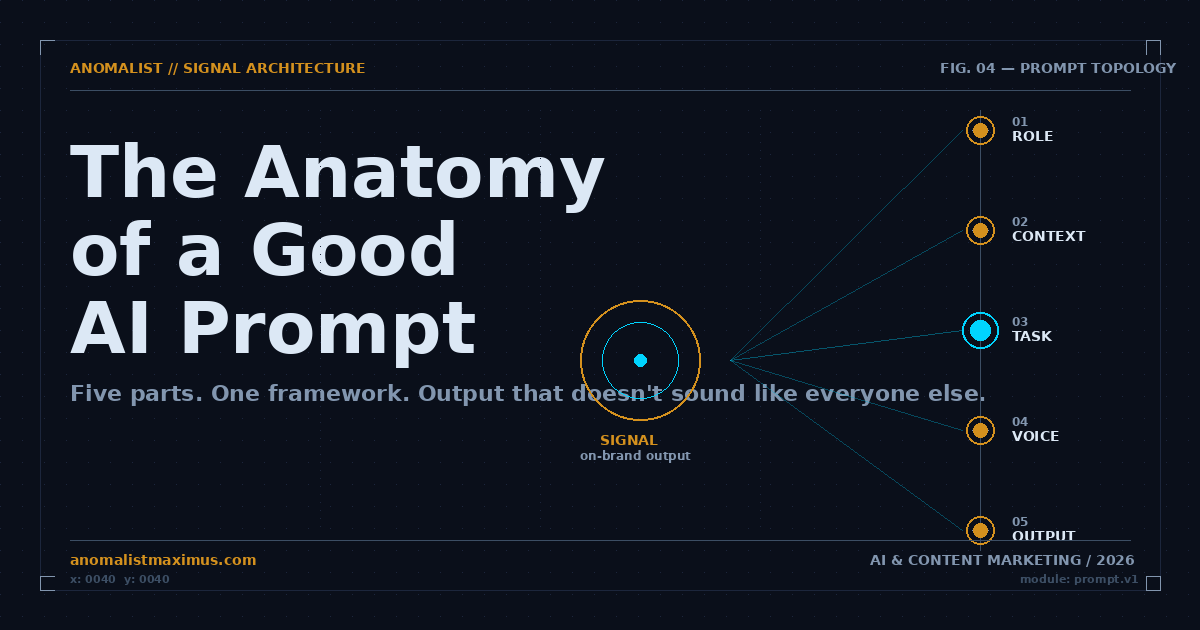
And good prompts have anatomy. Five parts. Every time. Skip one and you get slop.
Why Most Small Business Prompts Fail
The average prompt I see from a small business owner is between five and fifteen words. "Write a social media post." "Make me an email about a sale." "Give me five blog ideas."
That's not a prompt. That's a hint. You're asking a system trained on the entire internet to guess what you want, and then you're surprised when it gives you the average of the entire internet.
Generic input, generic output. There's no shortcut around that.
If your prompt could've been written by your competitor, your output will read like your competitor wrote it.
The fix isn't typing more for the sake of it. The fix is being deliberate about what you tell the AI. Five inputs, in this order, every time.
The 5-Part Framework
1. Role — Tell the AI Who It Is
Start by assigning a role. Not because the AI "becomes" anything, but because role assignment narrows the universe of patterns it pulls from. "You are a marketing strategist who writes for blue-collar service businesses" produces wildly different output than no role at all.
Be specific. "You are a copywriter who specializes in plumbing and HVAC small businesses, with 15 years of experience writing Facebook content that gets booked appointments." That single sentence eliminates 90% of generic marketing-speak before you even ask for the post.
2. Context — Tell the AI About Your Business
This is the part everyone skips. The AI knows nothing about your business. It doesn't know your service area. It doesn't know your price point. It doesn't know that your customers are mostly homeowners over 55 who found you through a neighbor. It doesn't know that you closed last year because of a flood, and your comeback story is part of how you market now.
Feed it. Two or three sentences of business context. "My business is a family-owned plumbing company in suburban Atlanta. We serve homeowners, mostly 45+. Our angle is that we don't upsell — we just fix what's broken. Our average customer found us through Facebook or a neighbor's referral."
That context bleeds into every word the AI generates after.
3. Task — Tell the AI Exactly What to Do
"Write a Facebook post" is vague. "Write a 90-word Facebook post about why summer is the worst time to discover your water heater is failing, aimed at homeowners over 45, with a soft CTA to book an inspection" is a task.
The more specific the task, the less guessing the AI has to do. And every guess it makes is a guess away from your brand.
Include the format (post, caption, email, ad), the length (in words or sentences), the angle (the specific hook or argument), and the audience. If you don't tell it the audience, it'll default to "general public" — which means it'll write for nobody.
4. Voice — Tell the AI How You Sound
This is the part that separates amateur prompts from prompts that produce content you can actually publish. AI doesn't know your voice unless you describe it or show it.
Two ways to feed voice:
- Describe it. "My voice is direct, slightly sarcastic, no corporate jargon. Short sentences. I use contractions. I never say 'leverage' or 'utilize.' I use 'you' constantly."
- Show it. Paste two or three examples of your past posts that you actually like. Tell the AI: "Match this tone exactly."
Showing beats describing every time. If you've got even five posts you're proud of, you've got a voice training set. Use it. We've written more on this in our piece on sounding like yourself with AI content — the voice work is what compounds.
5. Output — Tell the AI What "Done" Looks Like
The last part is constraint. What does a good answer look like? What should it not include?
Examples:
- "Give me three variations, not one."
- "No emojis except one at the end."
- "Don't start with 'In today's fast-paced world.' Don't end with a question."
- "First line must hook on its own — assume the reader will only see the first 12 words before deciding to keep reading."
Constraints aren't restrictions. They're the difference between "a post" and "a post that fits your channel, your reader, and your scroll-stopping standard."
The 5-Part Prompt in One Block
Here's what it looks like when you stack the five parts together. This is a real, usable template. Copy it. Customize the bracketed pieces. Paste into ChatGPT, Claude, or any AI tool you use:
You are a [ROLE — specific writer/strategist with relevant experience].

My business: [CONTEXT — what you do, who you serve, your angle, anything unusual about your customers].

Task: Write a [FORMAT] of [LENGTH] about [TOPIC]. The angle is [SPECIFIC HOOK]. The audience is [SPECIFIC PERSON].

Voice: [DESCRIBE — direct/conversational/dry/etc., 3-4 traits]. Words I use: [list]. Words I never use: [list]. Here's an example of my past content to match tone:

[PASTE 1-2 EXAMPLES]

Output: Give me [#] variations. Don't [SPECIFIC THINGS TO AVOID]. The first line must [SPECIFIC FIRST-LINE RULE]. End with [CTA OR CLOSING STYLE].
That's it. Roughly 150 words of prompt to get content that doesn't sound like AI sludge. Compared to the five seconds it takes to type "write me a Facebook post," it's a much better trade.
Common Prompt Mistakes That Kill Your Output
- Asking for "engaging" or "compelling" content. These words mean nothing to the AI. They mean nothing to anyone. Tell it what you actually want — a specific reaction, a specific tone, a specific reader behavior.
- Skipping audience entirely. Without an audience, the AI writes for "people on the internet." That's a ghost. Give it a real reader.
- Asking for one variation when you could ask for five. AI generates options at the same speed. Always ask for multiple. Pick the best. Edit it.
- Treating the first output as the final output. The first draft is the warm-up. The good content comes from your second prompt — the one where you tell it what to fix from the first.
- Forgetting to constrain length. AI defaults to over-writing. If you don't say "90 words," you'll get 240. Then you'll spend 10 minutes trimming.
How to Apply This Today
- Build one master prompt. Spend 30 minutes filling in the template above for your business. Save it as a note. This is the prompt you'll edit slightly for every piece of content going forward — not rewrite from scratch.
- Collect three voice examples. Find three pieces of past content (posts, emails, captions) that you'd be proud to publish today. These become your AI training samples. Update them every quarter.
- Make a "never use" list. Words and phrases your brand doesn't say. "Synergy." "In today's fast-paced world." "At the end of the day." Whatever yours are. Paste this list into every prompt.
- Always ask for variations. Three minimum. The fourth and fifth often beat the first by a wide margin. AI is bad at the first try and good at the fifth.
- Keep a "what worked" file. When the AI nails it, save the prompt that got you there. Build your own internal prompt library. This compounds faster than any tool upgrade ever will.
The Bottom Line
The businesses winning at AI content right now aren't using better tools than you. They're using better inputs. Same model, same subscription, totally different output — because they've internalized that the prompt is the work.
Five parts. Role, Context, Task, Voice, Output. Every time. Skip one and you'll know which one by reading the result.
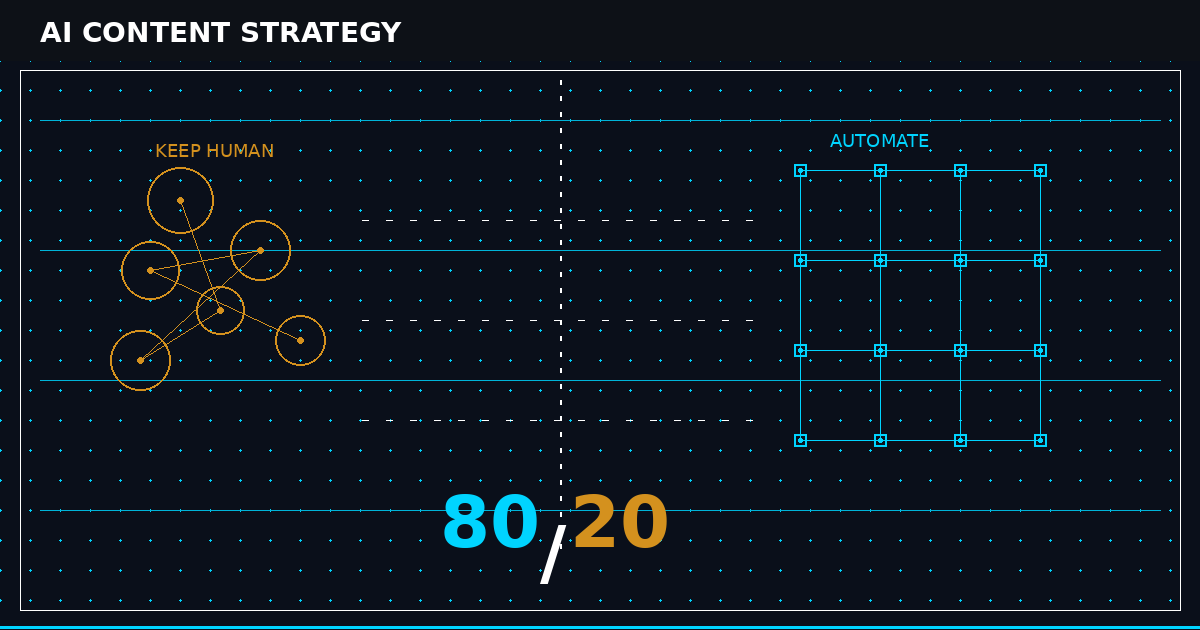
If you want to take this further and figure out where AI fits and where it doesn't in your workflow, our 80/20 rule of AI content walks through which 80% to automate and which 20% stays human. The prompt framework here is what makes that 80% actually work.