You don't have a content problem. You have a distribution problem.
Most small businesses think they need to write more. Write an Instagram caption. Write a LinkedIn post. Write an email. Write a Facebook post. Every platform, every day, net-new content pulled out of thin air. That's how people burn out in 60 days and quit.
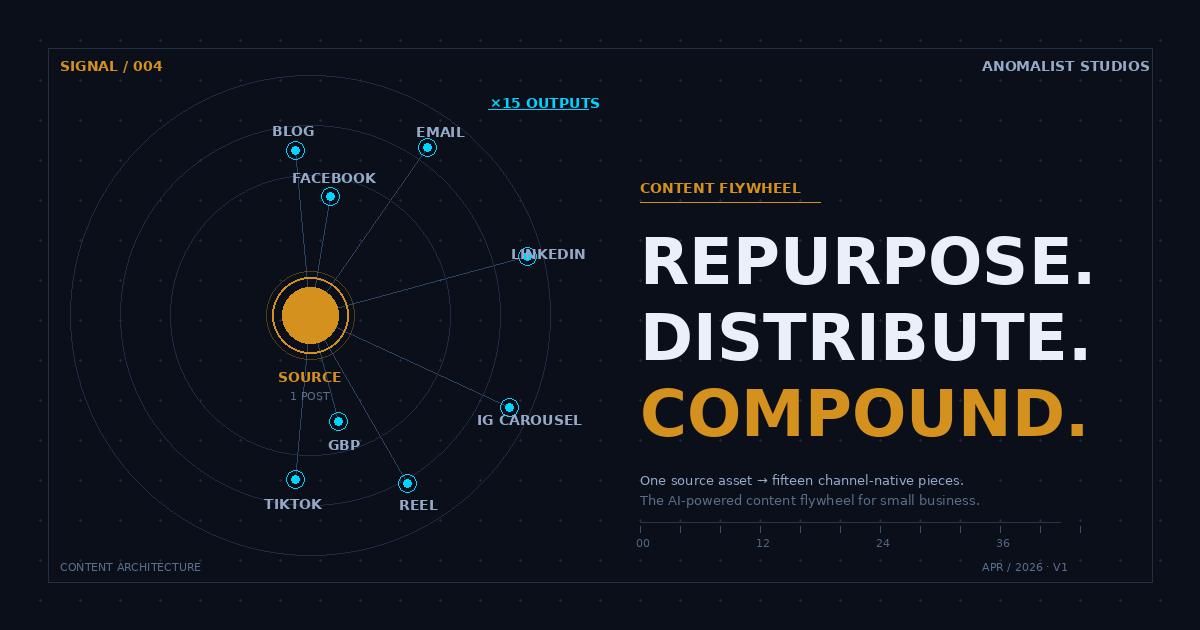
Here's the uncomfortable truth: the businesses winning at content right now aren't writing more. They're writing once, then strategically reshaping that one piece into ten, twelve, fifteen different formats for different channels. That's the repurposing flywheel. And with AI in the mix, it's finally something a one-person marketing operation can actually run.
Why Repurposing Is the Real Leverage
Think about what a single 1,200-word blog post actually contains. A central thesis. Three to five supporting arguments. A handful of examples. A few quotable sentences. A strong opening hook. A call to action. That's raw material for a dozen posts — you just have to extract and reformat it.
The mistake is treating every channel like it needs original research. It doesn't. Your LinkedIn audience isn't the same as your Instagram audience. Your email subscribers aren't seeing your TikTok. You can — and should — say the same thing five different ways for five different places.
The businesses winning at content in 2026 aren't writing more. They're extracting more from every piece they create.
The Flywheel Principle: One Source of Truth
Every repurposing system needs a center. That center is your source asset — usually a long-form piece of content you create first. Most small businesses use one of three source formats:
- A blog post — 800 to 2,000 words, researched and structured
- A recorded talk or podcast episode — 15 to 45 minutes, transcribed
- A detailed voice memo or Loom walkthrough — 5 to 10 minutes, transcribed
The source has to be yours. AI can help you polish it, outline it, or extract quotes from it — but the thinking, opinions, and specifics need to come from you. If the source is generic, every repurposed piece will be generic too. Garbage in, garbage out, multiplied across fifteen channels.
What One Blog Post Actually Gives You
Here's what a single strong blog post produces when you run the flywheel properly:
- 1 email newsletter — the main arguments, tightened for inbox reading
- 1 LinkedIn article — the same post, slightly longer intro for the LinkedIn audience
- 3 LinkedIn text posts — one hook, one counterpoint, one story pulled from the article
- 3 Instagram carousel posts — 7-10 slides each, covering the main points visually
- 2 Instagram single-image captions — a quote graphic and a hot-take commentary
- 2 short-form videos — one explainer, one hot take for Reels / TikTok / Shorts
- 2 Facebook posts — one community question, one quick tip from the article
- 1 Google Business Profile post — the practical takeaway, localized
That's fifteen pieces, and you've written the substance once. AI handles the reformatting and channel-specific voice adjustments. You handle the quality check at the end. If you're struggling to figure out how often to post on each platform, this approach fills a two-week calendar with room to spare.
Where AI Actually Helps — And Where It Doesn't
Let me be clear about what AI is doing in this workflow and what it isn't.
AI does well:
- Reformatting a paragraph into a hook-first LinkedIn post
- Extracting the three most quotable sentences from a 1,200-word article
- Converting a list into a carousel structure with slide titles
- Rewriting an email in a shorter, punchier voice
- Generating ten subject line variations so you can pick the best one
AI does badly:
- Having original opinions
- Knowing what your audience actually cares about
- Spotting when a repurposed post no longer makes sense outside its original context
- Writing hooks that sound like you, without careful prompting
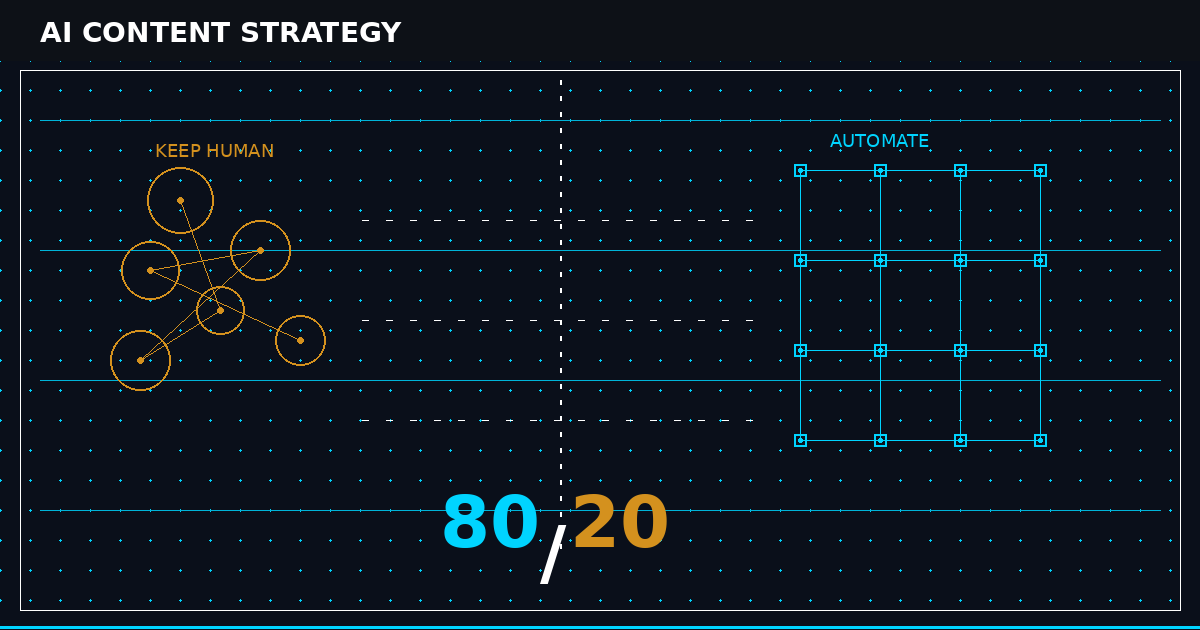
This is where it falls apart for most businesses: they try to hand AI the whole job. The workflow isn't "let AI do everything." It's "use AI to handle the mechanical reshaping, then you do the editorial pass." We go deeper on that split in The 80/20 Rule of AI Content — same principle applies here.
Build Your Own Repurposing System
Here's the actual playbook. Do this once, then run it every week.
- Pick your source format. One blog post per week is the gold standard for most small businesses. Pick a day, block two hours, write something real.
- Build a repurposing prompt library. Write one prompt per output format — "Turn this blog post into a 7-slide Instagram carousel with a hook slide and CTA slide." Save them. Reuse them every week.
- Feed your source into each prompt separately. Don't try to do it all in one mega-prompt. Separate requests produce tighter output.
- Edit every output before posting. Fix the voice. Add a specific example. Kill the generic phrases AI loves ("in today's fast-paced world," "it's important to note").
- Schedule across two weeks. Fifteen pieces from one post should fill your content calendar for 10-14 days depending on your posting cadence.
- Track which formats perform. After a month, you'll see which outputs actually get engagement. Lean into those. Kill the ones that die.
Common Mistakes to Avoid
- Publishing AI output raw. Every piece needs a human editorial pass. No exceptions.
- Making every platform sound identical. LinkedIn isn't TikTok. Adjust the voice for each channel — the tone, the length, the hook style.
- Repurposing weak source material. If your original post is vague or unoriginal, fifteen derivatives won't fix it.
- Posting all 15 pieces in the same week. Space them out. Let each one breathe. Nobody wants to see the same argument from you six times in four days.
- Forgetting visuals. Instagram carousels and Reels need images and video. AI won't shoot your phone footage for you.
- Using the same hook across every platform. Your LinkedIn hook should sound like LinkedIn. Your TikTok hook should sound like TikTok. Tell AI the platform every time you prompt it.
The Bottom Line
Content consistency is mostly an execution problem, not a creativity one. If you can produce one strong source asset per week and run a disciplined repurposing flywheel, you'll out-publish 95% of your local competitors without burning out.
The businesses winning at content in 2026 aren't writing the most. They're extracting the most value from every piece they create. That's the whole game.
Start with one blog post this week. Build the prompts. See what comes out. Cut through the noise.