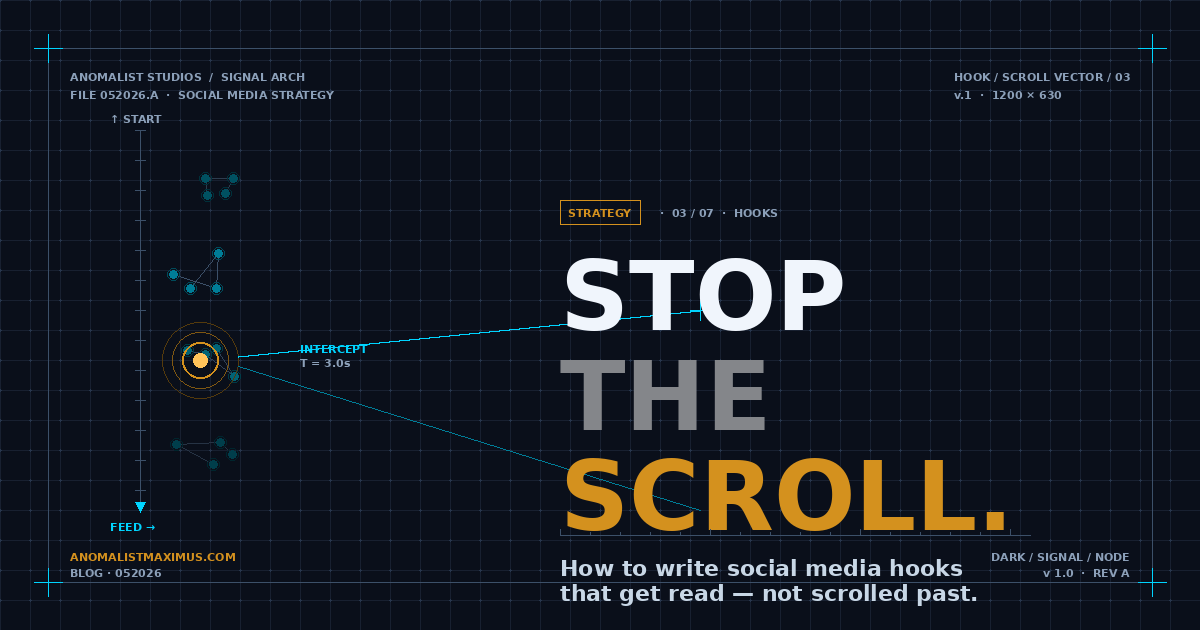
Here's the uncomfortable truth about social media: your post is competing with a baby photo, a political rant, a meme about Mondays, and an ad for sneakers — all in the same scroll. You have about one second to convince someone to slow down. Maybe two on a good day.
That window is the hook. It's the first line — sometimes the first three or four words — that decides whether the rest of your post gets read or buried under the next swipe. And most small businesses lose that fight before it starts, because they treat the hook like a throat-clearing throw-away.
"Excited to announce…" is not a hook. "Happy Friday everyone!" is not a hook. "We've been so blessed to serve our community…" is not a hook. Those are warm-ups that signal to the brain it's safe to keep scrolling. And the brain takes the hint.
This post is a deep dive on what actually works. The mechanics of attention, the seven hook structures small businesses can steal, how to test whether your hook is doing its job, and the mistakes that quietly kill posts before anyone sees the rest.
What a hook actually does
A hook has exactly one job: interrupt the auto-pilot. Nothing more. It is not where you sell, summarize, hashtag, or close. It is where you make a person's thumb pause for half a second longer than it would have.
Behavioral research on feed-based media — work coming out of Microsoft, Meta's own ad-effectiveness studies, and a 2024 Nielsen attention report — keeps landing on the same range: most people decide to keep scrolling or stop within 0.6 to 1.7 seconds of a post appearing on screen. That's the entire window. Caption length doesn't matter if you lose the first second. Hashtags don't matter if you lose the first second. Beautiful photography only buys you about 0.3 seconds of extra grace if the words don't carry weight.
The hook is not the headline of your post. It's the trigger that earns you the right to write a headline.
This is why "Happy Friday" fails. The brain registers it as social filler — a polite greeting that means nothing is at stake — and the thumb keeps moving. A working hook gives the brain a reason to slow down: a question it wants answered, a claim it wants to fact-check, a statement so specific that scrolling away would mean leaving something on the table.
The seven hook structures that work
You don't need to invent a hook from scratch every time. The vast majority of high-performing social posts pull from a small set of repeatable structures. Here are seven that actually move the needle for small businesses.
1. The contrarian opener
State the opposite of what your audience expects. "Most contractors are wrong about deposits." "Don't post on LinkedIn on Tuesday mornings." "Stop running Facebook ads to cold audiences." The mind treats contradiction as a question that needs resolving, so it stays.
The trick: only use it when you can actually back it up in the next two sentences. A contrarian hook with a soft follow-through feels like clickbait, and clickbait teaches your audience to never trust your first line again.
2. The specific number
"3 of every 10 small businesses lose a customer in the first 30 days." "Our average client posts 4.2 times per week." "We made $11,400 last month from one Instagram Reel." Specific numbers — especially odd, non-round ones — feel like data, not opinion. The brain notices specificity because it's the texture of truth.
Vague numbers do the opposite. "A lot of businesses…" and "tons of customers…" register as filler. If you say a number, make it real.
3. The named pain
Name the exact problem your audience is having today. "You wrote a post no one liked. Again." "You're paying for ads that don't book appointments." "Your inbox has three pending estimates and zero replies."
This one works because pain is the strongest attention magnet humans have. We are wired to look at our own problems. If you can describe the problem better than the reader can describe it themselves, you've already won the second sentence.
4. The unexpected question
Not the limp kind — "Have you ever wondered about…?" — but the specific kind. "Why do most plumbers undercharge by 22%?" "What's the one number your dentist watches every Monday morning?" The pattern is: a question the reader does not currently have an answer to but suddenly wants one.
Questions only work if the answer feels valuable. "What's your favorite color?" earns a thumb-scroll. "What's the one question you should ask before signing any insurance policy?" earns a stop.
5. The scene cut
Drop the reader into the middle of a moment. "Last Tuesday a customer called me crying." "It's 11 p.m. and I'm still reading rejection emails." "The contractor showed up an hour late, smelling like cigarettes." Cinematic openings work because they invite the reader to find out what happens next.
If you've ever read a great novel that opens mid-action, this is the same mechanism. Don't ramp. Cut.
6. The blunt confession
Admit something most people wouldn't. "I lost a $14,000 client last week because I missed an email." "I almost shut the business down in 2023." "We've been overcharging our cheapest tier for two years and I knew it." Vulnerability is rare on social media. When it shows up, attention follows.
This isn't oversharing — it's strategic transparency. The confession should always teach something. Otherwise you're just venting at people.
7. The micro-promise
Tell the reader exactly what they'll get if they keep reading. "Here are three lines you can copy into your next Facebook post." "I'll show you the exact email I send when a quote ghosts me." "Three minutes from now, you'll know whether your Google Business Profile is bleeding leads."
Micro-promises work because they remove ambiguity. The reader doesn't have to guess what's in it for them. The cost is clear (a short read) and so is the reward (a specific takeaway). Just make sure the body delivers what the hook promised, or you'll train your audience to ignore future hooks.
How to test if your hook is working
Hooks are not abstract — they leave fingerprints in your analytics. You can tell a working hook from a dead one in less than 48 hours after the post goes live. Two things to watch:
The first-screen retention. On Facebook and Instagram, this shows up as the average view duration on Reels or the "fully expanded" rate on long captions. If most people are bouncing in under one second, the hook didn't land. On LinkedIn, watch the post-impressions-to-clicks-on-"see more" ratio. If fewer than 10% of impressions click to expand, the first two lines aren't pulling.
The save and share count, not the like count. Likes lie. People will tap a heart on autopilot. Saves and shares require effort, which means the post actually broke through. A great hook produces saves and shares disproportionate to its likes. If your saves are flat across posts, you're probably opening every one the same way.
A good rhythm: every week, sort your posts by save rate. Look at the top three hooks. Look at the bottom three. The patterns will be obvious within a month. We dug deeper into this measurement question in our piece on social media ROI for local businesses — vanity metrics will fool you if you're not careful what you watch.
Platform tweaks: the hook isn't quite the same everywhere
The seven structures work everywhere, but the format around the hook changes by platform. A hook that crushes on LinkedIn can flop on Instagram for purely structural reasons.
The hook is the first sentence visible above the "See more" fold — typically the first 120-150 characters before the truncation kicks in. Write the entire hook before the cut. If the reader has to expand to find out what you're saying, you've already lost most of them.
Captions get truncated even harder — usually around 125 characters. But the visual carries half the weight here. Your hook is actually a combination of the first frame of the photo or video and the first line of the caption. They have to agree. A serious confession-style caption under a cheery group selfie will feel off, and the brain treats "off" as a reason to keep scrolling.
LinkedIn truncates at three lines on mobile, two on desktop. You have more real estate than Instagram, so a slightly longer cinematic opener or named-pain hook works well. Avoid corporate throat-clearing entirely on this platform — "Excited to share…" is a signal to the algorithm and the audience that nothing real is coming.
X / Threads
The hook IS the post. There's no body to bury it before. Lean on specific numbers, blunt confessions, and contrarian openers. Save the scene-cut and unexpected-question structures for platforms with more breathing room.
TikTok / Reels / YouTube Shorts
The hook is auditory and visual, not textual — but the principle is identical. The first 1.5 seconds need to interrupt the autopilot. The same seven structures translate: open with a contrarian claim, a specific number, a named pain, a scene, a question, a confession, or a micro-promise. Just deliver it on camera instead of in the caption.
A practical workflow for writing better hooks
Here's how to put this into a usable habit instead of a one-time read:
- Write the post body first. Don't try to nail the hook on the first draft. Write the meat — the story, the lesson, the takeaway — then look at it and ask: "What's the single most surprising or specific thing in here?" That's your hook material.
- Generate three hook options, not one. Use three different structures from the list above. A contrarian, a specific number, and a named pain. Pick whichever feels least like something you've already posted this month.
- Read it cold. Walk away for ten minutes, come back, read just the first line out loud. If you wouldn't stop scrolling on it yourself, rewrite it. Brutal but reliable.
- Cut every word that doesn't earn its spot. Hooks tighten under pressure. "I think a lot of small business owners probably struggle with…" becomes "Most small business owners struggle with…" becomes "Most owners get this wrong." Shorter and meaner almost always beats longer and softer.
- Match the hook to the platform. Make sure it fits within the truncation window for whichever platform you're posting on. Test on a phone, not a desktop — that's where 90% of your audience reads.
- Track which structures pull for your audience. After 30 days, you'll see one or two patterns that outperform the rest for your specific audience. Lean into those. Drop the ones that flatline.
This isn't a creative-genius problem. It's a discipline problem. The businesses that get this right are not the ones with the wittiest writers — they're the ones who treat the hook as the most important sentence in the entire post and edit it accordingly.
Common mistakes that kill hooks
- Opening with "Happy [Day]" or "Hi friends." These are throat-clearing. They tell the brain nothing is at stake. Cut them every time.
- Burying the hook behind context. "I was at a coffee shop this morning thinking about a conversation I had last week with one of my clients…" Just start with the conversation. The setup is killing you.
- Front-loading hashtags. Hashtags at the top of a post signal "this is marketing." That alone teaches the reader to scroll. Put them at the bottom or in a comment.
- Generic announcements. "Excited to announce our new service!" gives the reader nothing to be excited about. Lead with the result, the surprise, or the cost — not the announcement itself.
- Trying to please everyone. A hook that's relevant to your entire mailing list is usually relevant to no one in particular. The sharper the audience, the sharper the hook can be.
- Asking soft questions. "Anyone else feel tired on Mondays?" has no stakes. "Why do most small businesses lose money on Mondays?" earns a read.
- Recycling the same opener every week. If your last six posts all start with "Today I want to talk about…" your audience is filtering you out subconsciously. Vary the structure on purpose.
- Letting AI write the hook untouched. AI tools default to safe, polite openings. They're great at body copy and ideation, but you almost always need to rewrite the first line yourself. (More on staying authentic with AI in how to sound like yourself when AI is writing your content.)
The bottom line
You're not losing on social media because your products are bad or your brand is invisible. You're losing because the first second of every post is doing nothing for you. Fix the hook and most of your other social media problems quietly get smaller.
Pick a structure. Cut the throat-clearing. Write the first line like it's the only line that matters — because to most of your audience, it is. The rest of the post only gets a chance to do its job if the hook earns it that chance.
Social media isn't a megaphone. It's a marketplace of one-second auctions, and the hook is your bid. Cut through the noise. Stop the scroll. Then say something worth staying for.