You hit Post. You close the app. You come back four hours later. Eleven likes, two comments from your mom, and that quiet sinking feeling that the universe just doesn't want to see your business succeed.
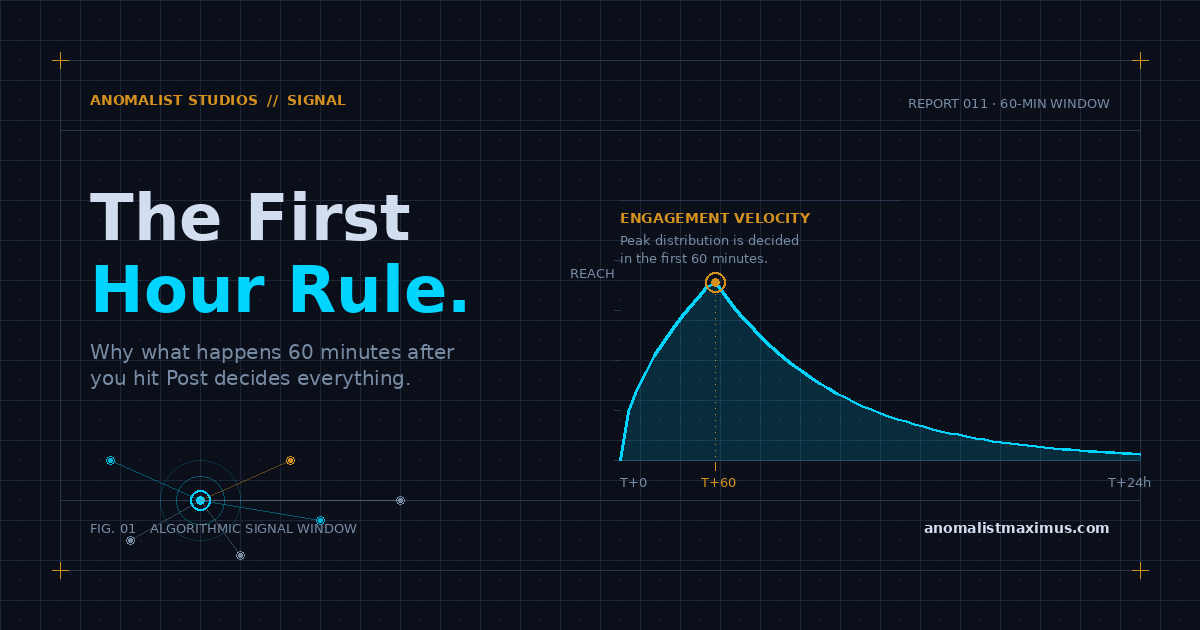
Here's the uncomfortable truth: the universe wasn't even in the room. By the time you opened the app to check, the decision had already been made — and it was made in the first 60 minutes after you published. Everything else was just the algorithm carrying out a sentence it had already passed.
What Actually Happens in the First Hour
Every major platform — Facebook, Instagram, LinkedIn, TikTok, YouTube Shorts — runs the same basic playbook when you publish. They show your post to a small test group first. Maybe 5% of your followers. Maybe a sample of relevant non-followers. They watch how that group reacts.
Then, based on the engagement signals from that test group, the platform decides one of three things:
- This is good. Push it harder. Show it to more followers, then to non-followers in the same interest cluster. Now you're in the algorithm's good graces and reach compounds.
- This is fine. Show it to a normal slice of your followers and move on. Nothing special, no penalty.
- This is dead. Suppress further distribution. Your followers won't even see it. The post becomes invisible without ever being officially blocked.
That decision gets made fast. On TikTok and Instagram Reels, often within 30 minutes. On Facebook and LinkedIn, usually within 60 to 90 minutes. By the time you're checking it at lunch, the verdict is in and the post is either being amplified or quietly buried.
This is why two posts you wrote in the same afternoon can have completely different fates. One gets 4,000 views. The other gets 84. It's not because one was better. It's because one had a strong first hour and the other didn't.
Why Your "Best Time to Post" Spreadsheet Is Lying to You
There's an entire industry built around telling small business owners that 2:14 PM on Tuesdays is the magic posting time. Generic best-time charts are mostly noise. They average across millions of users in dozens of industries across multiple time zones, then hand you the mean as if it applies to your bookkeeping firm in Tulsa.
What actually matters is when your specific audience is awake, on their phone, and likely to react quickly. That window is a function of your industry, your customer base, and your geography — not a generic chart. Restaurants and HVAC companies have completely different rhythms. So do B2B and B2C audiences. And they all move depending on the day of the week.
The "best time to post" isn't a number on a chart. It's the window when your specific audience is most likely to react in the first 15 minutes.
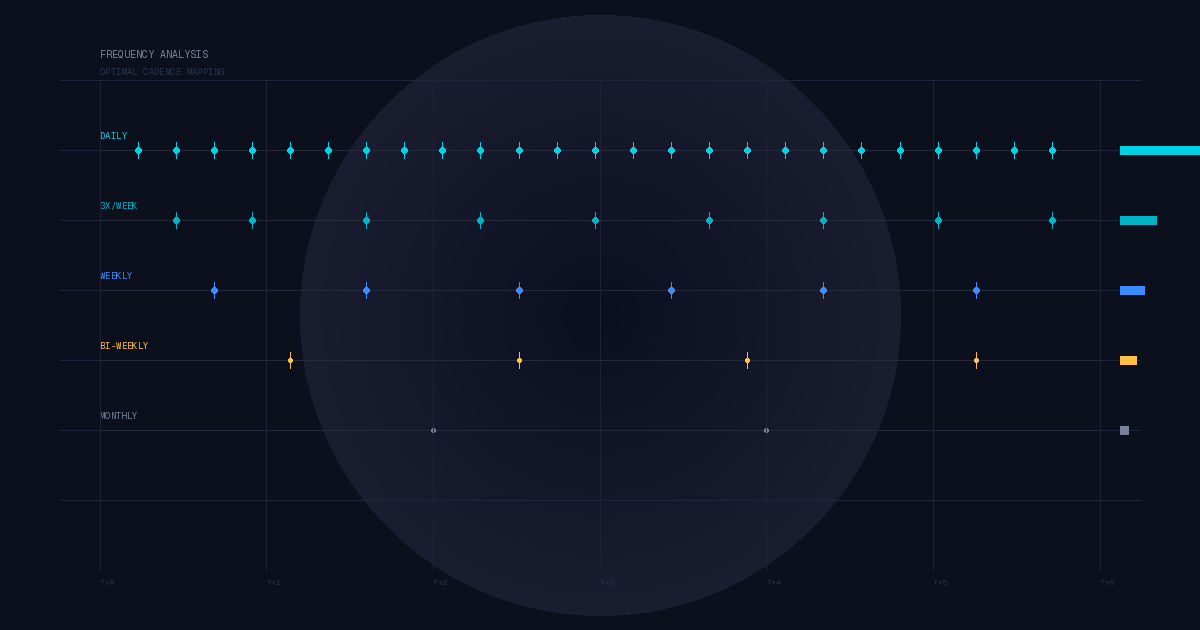
The fastest way to find your real window: post the same type of content at three different times for three weeks, look at the engagement-per-impression in the first hour for each, and pick the winner. That's it. Three weeks beats anyone else's recommendation, because the data is yours.
The Three Engagement Signals That Actually Matter
Not every reaction counts the same. Algorithms grade your first hour on a weighted scale, and most small business owners are optimizing for the wrong column.
1. Meaningful Interactions, Not Likes
A like is the cheapest action a user can take. Algorithms know that, and they discount it accordingly. Comments, shares, and saves are dramatically heavier signals — sometimes weighted 10x or more compared to a like. A post with 30 likes and 8 thoughtful comments will outperform a post with 200 likes and zero comments. Every time.
2. Watch Time and Dwell Time
If you're posting video, the platform doesn't just care that someone tapped play — it cares whether they watched to the end, watched twice, or scrolled away in two seconds. For static posts, the equivalent is "dwell time": how long someone lingered on your post in their feed before scrolling. This is invisible to you in your analytics, but it's a huge factor in distribution.
3. Speed of Engagement
Ten comments in the first 30 minutes is a vastly stronger signal than ten comments spread across a day. Velocity matters. The platform reads early speed as a proxy for "people care about this," and amplifies accordingly. This is why a post that hits its rhythm right away keeps compounding, while a slow burner often never finds its audience at all.
The Setup Work You Do Before You Hit Publish
Here's where it falls apart for most small businesses: they treat publishing like a finish line. Type, attach image, click. Done. Walk away.
The serious operators treat publishing like a starting gun. Everything they do before they hit Post is designed to win the first 60 minutes.
Specifically:
- The hook is interrogated. The first line of the caption (or the first three seconds of the video) is reworked until it earns the scroll-stop. If the hook isn't earning, the rest of the post is irrelevant — because most people will never see it.
- The call-to-engage is built in. Not a CTA to "visit our website." A direct invitation to comment, share an opinion, save the post, or tag someone. The platform needs people doing things in the first hour. Give them something specific to do.
- The publishing window is intentional. The post goes live when the owner can actually be present for the next 60 minutes — not at midnight before they go to bed, not during a flight.
- The first reply is staged. The owner or a team member has a question or comment ready to drop in within five minutes, both to seed the conversation and to send an "active thread" signal to the algorithm.
None of this is glamorous. All of it is the difference between distribution and burial.
The First-Hour Playbook
If you only change one thing about how you post, change this: build a 60-minute ritual around the moment your post goes live. Here's the sequence:
- Minute 0 (publish). Hit Post when you can physically be on the phone for the next hour. Not before. Not after.
- Minute 1-5. Drop your own first comment with a follow-up question or extra detail. This isn't cheating — it's creating an entry point for the next person who lands on the post.
- Minute 5-15. Notify three to five real people who would actually find this interesting. Not a mass DM blast. A specific, personal "thought of you when I wrote this" message that earns a real reply. Their early engagement is your strongest velocity signal.
- Minute 15-30. Reply to every comment as it lands — and reply substantively. Not "thanks!" A real sentence. Real replies extend dwell time on the thread and signal that this is a live conversation.
- Minute 30-60. Share the post into one or two communities, group chats, or DMs where it's genuinely relevant. Not your personal feed twice. Places where new humans will see it.
- Minute 60-90. Stop. Walk away. Don't keep refreshing. The decision is made. Save your energy for the next post.
Done consistently, this ritual moves your average post out of the dead zone and into the "this is fine" tier, and pushes your better posts into the "push it harder" tier. It compounds. Three months of disciplined first-hour ritual will outperform a year of post-and-pray.
If you're already running a defined content pillar system, this is the operational layer that turns those pillars into actual reach. Without the first-hour ritual, even great content gets buried.
Common Mistakes Killing Your First Hour
- Posting and ghosting. Publishing right before a meeting, a flight, or bedtime. If you can't be present, schedule it for when you can be.
- Begging for engagement instead of earning it. "Comment YES if you agree!!" reads as low-effort and the algorithm has gotten better at spotting it. Earn the comment with a real question or a real opinion.
- Editing the post 10 minutes after publishing. On most platforms, editing a recently-published post resets its distribution clock or actively suppresses it. Catch typos before you hit publish.
- Replying with one word. "Thanks!" "💯" "🙌" — these are dead-end replies. The algorithm reads them as low-value and the original commenter doesn't get a real conversation. Use real sentences.
- Cross-posting identical content the same hour. Splitting your audience's attention by dropping the same post to Facebook, Instagram, and LinkedIn simultaneously dilutes the first-hour signal everywhere. Stagger them by 1-2 hours minimum and adapt the format for each platform.
- Posting links in the caption. Most platforms suppress reach on posts that pull users off-platform. Put the link in the first comment, or in your bio with "link in bio" — and accept the friction.
- Checking metrics obsessively. Refreshing your own post drives up dwell time on your end, but it doesn't help the algorithm. Worse, it pulls your attention from the actual work — engaging with the people commenting.
What to Do When a Post Bombs Anyway
Some posts die in the first hour even when you do everything right. Don't fight it. Don't delete it and repost — that signals desperation and platforms have started flagging it. Don't boost it with paid spend in the first 24 hours hoping to revive organic reach — paid distribution doesn't fix a weak engagement signal, it just shows the post to more people who will ignore it.
Instead, do the post-mortem. Was the hook weak? Was the timing wrong for your audience? Did the question at the end actually invite a response, or was it rhetorical? Write down the lesson and let the post fade. The win is in the next one, not the last one.
This is also where customer language becomes a competitive advantage. Posts written from real customer conversations almost always have stronger first hours than posts written from inside your own head — because they start with a hook the next customer would actually search for at 11 PM.
The Bottom Line
Reach isn't random. It's the sum of decisions algorithms make in the first hour after you publish — decisions driven by signals you mostly control. Most small business owners are losing the first hour by accident: posting at the wrong time, ghosting the comments, begging for engagement, splitting their audience across three platforms simultaneously.
The fix isn't a better caption generator or a bigger ad budget. It's a 60-minute ritual built around the moment you publish. Show up for that window. Earn the early engagement. Reply like a human. Let the algorithm see that this post matters to real people. Then walk away.
Do that consistently and your reach stops being a coin flip. Cut through the noise.