Here's the uncomfortable truth about referrals: every small business owner I talk to says they're "mostly word of mouth." Then I ask how many referrals they got last month. Most can't tell me. A few guess. Almost none have a number.
That's the whole problem. Referrals are the cheapest, highest-trust customers you'll ever get — and most businesses treat them like weather. Something that just happens. Something you hope for.
It doesn't have to be that way. A referral loop is a small, repeatable system that turns satisfied customers into a steady source of new ones. It's not a software product. It's not a fancy program with punch cards and tiers. It's a handful of moments you design on purpose instead of leaving to chance.
Why most small businesses fail at referrals
It's not because customers don't like you. It's because nobody ever asked them to do anything.
The average happy customer wants to help you. They're not sitting around looking for opportunities to recommend you, but if you make it easy and obvious, they will. The breakdown happens in three places:
- Timing. You ask at the wrong moment — usually long after the customer's enthusiasm has cooled.
- Ask. You don't actually ask. Or you ask in a way that's so vague the customer doesn't know what you want.
- Friction. Even if they're willing, sharing your business takes effort. They have to remember your name, find your website, think of who to tell, and figure out how to introduce you.
Fix those three, and you've built the loop. That's the whole job.
What a referral loop actually looks like
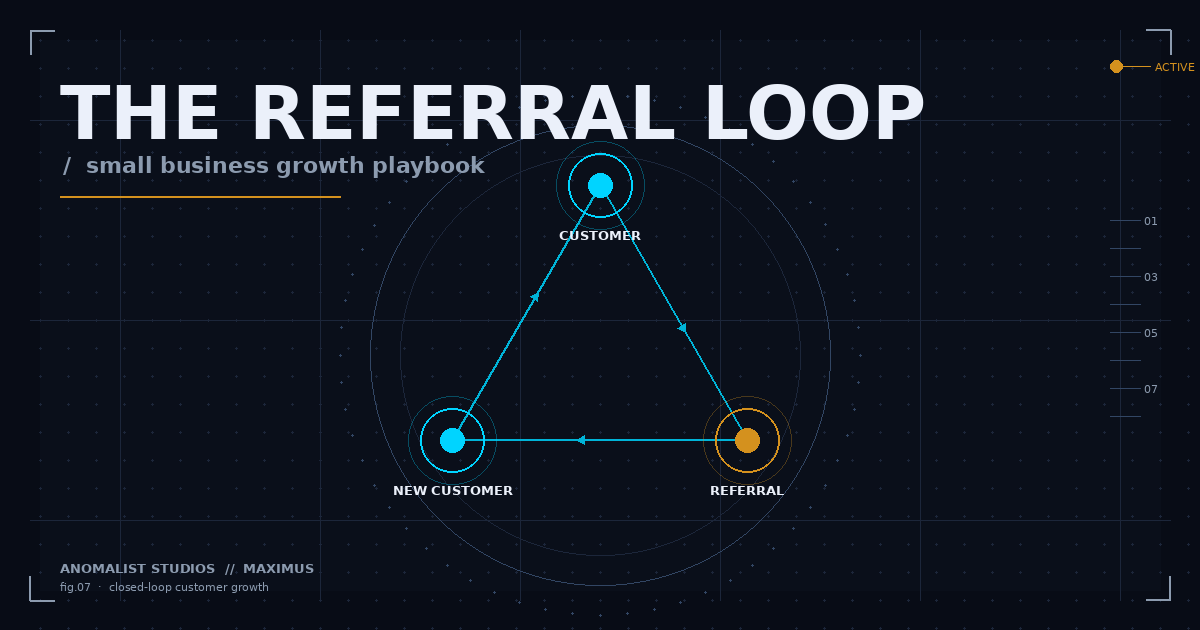
Picture three moments connected in a triangle. A customer has a great experience. You ask them to share it. They tell someone. That person becomes a customer. Now you're back at the top of the triangle with someone new.
The loop isn't a campaign. It's a habit you bake into how you run the business.
What makes it a loop instead of a one-off is that every new customer enters the same system. You don't have two kinds of customers — referred and not referred. You have one process that quietly turns satisfaction into the next sale.
The three moments you need to design
1. The peak moment
There's a specific instant when a customer is most likely to recommend you. Behavioral researchers call it the peak — when the value of what you did is fresh and the satisfaction is loudest. For a roofer, it's the day after the job, when the homeowner is staring at a clean new roof. For a dentist, it's right after a positive checkup. For a restaurant, it's when the bill comes and the meal was great.
Most businesses miss this window completely. They send a follow-up email two weeks later when the moment is gone. Map your peak. Mark it on a sticky note if you have to. That's when you ask.
2. The clear ask
"Tell your friends about us" is not an ask. It's a hope. A real ask is specific, easy to answer, and small.
Compare these two:
- "If you know anyone who could use us, send them our way." (Vague. Forgettable.)
- "Do you know one person who might be looking for a new dentist this year? I'd love to take care of them too." (Specific. One person. Personal.)
The second one works because it gives the customer a concrete thing to do. One person. This year. That's solvable in their head right now.
3. The easy handoff
Even when a customer is willing, they'll often forget by the time they see someone they could refer. Hand them something that does the remembering for them.
It can be as simple as a small business card with a QR code linking directly to your booking page. A pre-written text message they can copy and paste. A landing page that says "[Customer Name] sent you — here's 10% off your first visit". Anything that closes the gap between intention and action.
How to actually build this in a week
- Pick your peak moment. Walk through your customer journey and mark the one point where satisfaction is highest. Not where it's convenient for you — where it's highest for them.
- Write the ask. One sentence. Specific. Asks for one person, not "anyone." Practice saying it out loud until it doesn't feel like a sales pitch.
- Make the handoff tool. A card, a link, a short text — whatever fits how your customers communicate. If you're not sure, start with a simple landing page with your name, what you do, and a way to book or call.
- Train one trigger. Decide who delivers the ask and when. If it's you, set a recurring task. If it's a team member, write it into the script. Make it impossible to forget.
- Track the number. Even a tally in a notebook. How many referrals came in this week? Last week? You can't improve a loop you don't measure.
- Close the thank-you loop. When a referral lands, tell the original customer. A short thank-you text, a handwritten note, a small thank-you credit on their next visit. This is what turns a one-time referral into a habit. People who get appreciated for referring tend to do it again.
That's the whole build. Six steps. Most of the work is in deciding — once you decide, the system runs itself.
Common mistakes that kill the loop
- Paying for referrals up front. Cash bounties make customers feel like salespeople, and the people they refer can tell. A thank-you after the fact works better than a bribe before.
- Over-engineering the program. Tiers, points, dashboards, rewards catalogs — you don't need any of it. A clear ask and a clear thank-you outperforms a "Refer-A-Friend Loyalty Pro Plus" page every time.
- Asking too soon. Don't ask before the value has landed. Asking a customer to refer you mid-project, before they've felt the outcome, feels desperate.
- Asking only once. Build the ask into multiple natural touchpoints — completion, follow-up, anniversary. Each one is a fresh peak.
- Treating digital referrals as separate. A five-star review, a tagged Instagram post, a Facebook recommendation — those are referrals too. Same loop applies. Same thank-you matters. (We wrote more about this in how to measure social media ROI for local businesses.)
- Not closing the gratitude loop. If a customer refers someone and you don't acknowledge it, they assume you didn't notice. They stop. The thank-you is not optional — it's the fuel.
What this looks like at scale
You don't need to scale this. That's the point.
A small business with a working referral loop will pull in 20–40% of new customers from existing ones. Some industries — insurance, financial services, home services — can push that higher. That's not a marketing campaign. That's the back half of every customer relationship doing quiet work for you.
Compare that to spending the same energy on cold ads. Referred customers convert faster, spend more, and stay longer. They came in pre-sold. The trust transfer from the person who recommended you is the most valuable thing you didn't pay for.
And it compounds. Every new customer who comes in through the loop is a candidate to enter the loop themselves. That's the difference between a transaction and a system.
The bottom line
You don't need a bigger marketing budget. You need a referral loop.
Pick the moment. Write the ask. Make the handoff easy. Thank people on the way out. Do that consistently and you'll spend less on customer acquisition while the customers you do get are warmer, stickier, and worth more.
Most small businesses leave this on the table because it doesn't feel like marketing. It feels like asking. But asking — done well, at the right time, for one specific thing — is the highest-leverage marketing move a small business can make. Cut through the noise. Build the loop.