Most dental practices treat social media like a dusty waiting-room magazine: technically there, technically updated, completely ignored. Every Tuesday a stock-photo smiling family goes up. Every Friday a "Happy Friday from our team!" graphic appears. The practice manager pulls up the metrics at the end of the month, sees zero new patients from social, and asks the question every dentist eventually asks — "Is this even worth it?"
Here's the uncomfortable truth: it's not the platform. It's not that dentistry is "boring." It's that most practices are posting content that doesn't answer the only question a prospective patient is actually asking — "Why should I trust you with my mouth?"
For dental practices, social media isn't a vanity channel. It's trust-building infrastructure. Industry research consistently shows that the majority of new patients now research a dental provider online before booking, and a practice's social presence directly influences whether they pick up the phone. That's not "nice to have." That's the front door.
But trust isn't built by posting hygiene tips your audience already knows, or by reposting the same "We're open Saturdays!" graphic for the third time this month. It's built by being a recognizable, credible, slightly-more-human version of your practice — the kind of presence that makes a nervous patient go, "Yeah, I think I'd be fine going there." That's a specific job. And it requires specific content.
Why Most Dental Practice Social Media Quietly Fails
There's a pattern I see across dozens of dental practices when I audit their feeds, and it goes like this. The practice has a hygienist who's been told to "handle the Instagram." She's not a marketer — she's a hygienist. So she does what she thinks marketers do: posts inspirational quotes, holiday graphics, and the occasional close-up of a Cavitron because, hey, that's the equipment.
The content isn't bad. It's just generic. And generic doesn't book patients.
Here's the deeper problem: dental practices tend to post about themselves — our anniversary, our new chair, our team retreat — while patients want content about themselves — what's going to happen at the appointment, will it hurt, what does the procedure cost roughly, do you take my insurance, what happens if I haven't been in years. The mismatch is enormous, and it's the single biggest reason practices feel like they're shouting into a void.
Let me be more specific. A patient considering booking a new-patient exam is running a checklist in their head, mostly subconsciously:
- Are they actually accepting new patients?
- Will the dentist talk down to me?
- Are they going to push services I don't need?
- Will the office be modern, clean, and calm?
- Do they take my insurance?
- What if I've avoided the dentist for years — are they going to lecture me?
Your social media should be answering one of those questions in nearly every post. If it isn't, you're posting filler. This is the same fundamental gap behind why most small businesses fail at social media in general — they post for themselves instead of for the person they want to reach.
The Trust Equation Patients Actually Care About
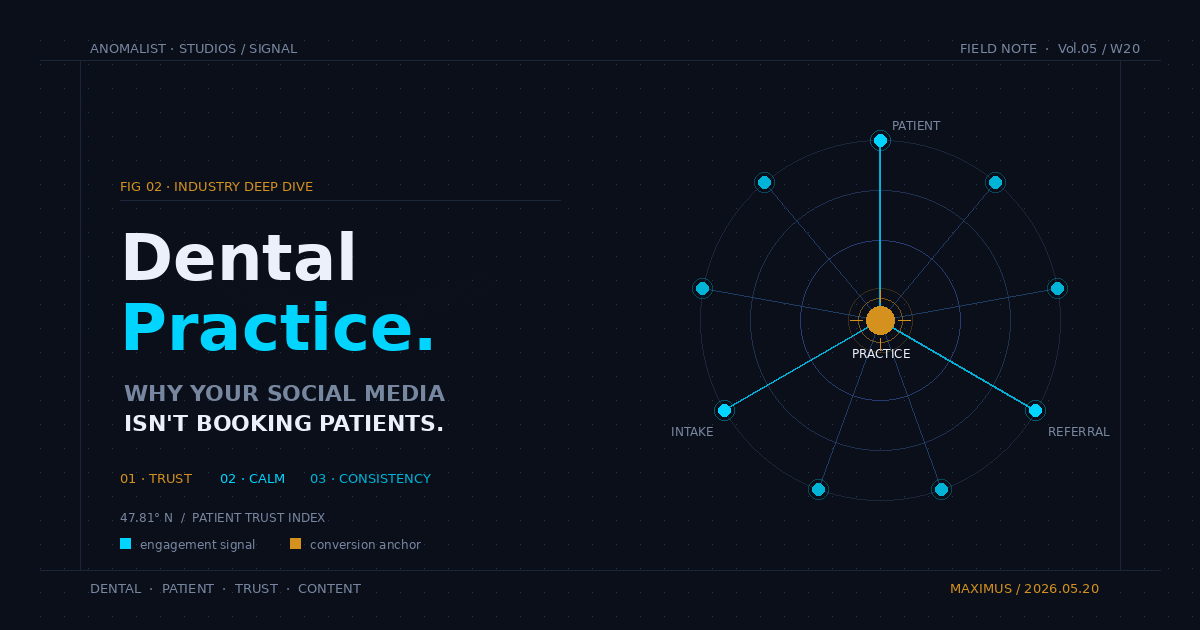
When patients evaluate a practice on social, they're scanning for three signals: competence, calm, and consistency. Get all three and they call. Miss one and they keep scrolling.
Competence
Patients can't evaluate clinical skill directly. They evaluate it by proxy. What does the office look like? Does the dentist explain things clearly on video? Is there before/after work that's tasteful and not gimmicky? Are there real reviews — with specifics, not five-stars-no-text drivebys? Modern equipment, clear communication, and tidy facilities all read as "this person knows what they're doing." You're not bragging. You're showing.
Calm
Dentistry triggers anxiety for a meaningful chunk of the population — the American Dental Association estimates roughly 36% of Americans have dental fear, with about 12% experiencing extreme dental anxiety. If your content is all bright lights and zoomed-in instruments, you're activating that fear. If your content is warm lighting, calm voiceover, friendly explanations of what to expect — you're disarming it. The single highest-ROI shift most practices can make is replacing clinical-looking imagery with warmer, more domestic visuals of the space and the people in it.
Consistency
A feed with five posts in 2025 doesn't inspire trust. A feed with three posts a week, every week, for the last six months does. Patients aren't reading every post — they're checking that you're alive, active, and not a practice that closed in 2023 and forgot to take the page down. Gaps in your posting cadence read as instability, even if the practice is thriving. Cadence matters more than perfection.
Most dental practices win or lose on social before a patient ever clicks "Book." They win by feeling steady, modern, and human. They lose by feeling generic, sporadic, and corporate.
The Content Mix That Books Appointments
You don't need to be clever. You need to be useful and recognizable. Here's the mix I recommend for a typical general or family practice, broken down by post type and weekly target.
Behind-the-scenes (2x/week)
Short videos or photos of the office. The hygienist setting up a room. The team dog allowed in on Fridays. A peek at the new intraoral scanner. The lobby on a quiet morning. This is where competence and calm get communicated visually. It doesn't need to be polished — phone footage is fine, often better. Polished = ad. Real = trust.
Patient-facing education (2x/week)
Not "brush twice a day." Something specific. "What actually happens during a deep cleaning, in plain English." "Why your dentist asks about your blood pressure." "What insurance pre-authorization means and why we do it." "How to tell the difference between a filling that needs replacing and one that's just stained." Address the questions people Google after their appointment but never ask in the chair.
Team and culture (1x/week)
Spotlight one team member. Two sentences about how long they've been there, one specific thing patients love about them. ("Maria has a near-magical ability to make 4-year-olds laugh through their first cleaning.") People book people, not LLCs.
Reviews and patient stories (1x/week)
Reformatted Google reviews — with permission — turned into clean graphics. Or a 30-second video testimonial from a patient who agreed to share. Specifics matter: "I hadn't been to the dentist in eight years and they didn't make me feel bad about it" is worth more than a hundred "Great staff!" reviews.
Calls to action (1x every 10 days, not more)
"Accepting new patients." "Saturday slots available this month." "Reminder: most insurance benefits reset January 1." These convert. But space them out, or your feed becomes an ad and people tune out.
That's roughly 6 to 7 posts per week. If that sounds like a lot, you're not wrong. It is. Which is why most practices either burn out a team member trying to do it manually or end up doing nothing for months at a stretch. The practices that win this either hire it out, build a real system, or use a content engine that actually understands their industry.
Five Practical Steps to Fix Your Practice's Social Media This Quarter
If you want to turn this around in the next 90 days, here's the order to do it in.
- Audit the last 90 days of your feed. Open Instagram and Facebook. Look at the last 30 posts. Count how many actually answered a question a patient might have. If it's fewer than 10, your content mix is the problem — not the algorithm, not the platform.
- Pick one platform and dominate it. If you're a family practice in a suburb, Facebook plus Instagram. If you're a high-end cosmetic practice in a city, Instagram and possibly TikTok. If you're a pediatric practice, Facebook for parents and Instagram for younger families. Don't bother with LinkedIn unless you're courting referrals from other providers. Focus beats spread, especially while you're getting started.
- Build a 30-post content bank before you post anything new. Sit down for one afternoon with the team. Write out 30 post ideas across the five categories above. This is the most underrated step. Practices fail because they go week-by-week, scrambling for ideas every Monday. Practices win because they batch.
- Set a posting schedule and treat it like a clinical appointment. Three posts a week, same days, same time-ish. Add it to the office calendar. Assign one person as owner. If that person is the dentist, fine — but only if the dentist will actually do it. Otherwise delegate it real, not nominally.
- Track exactly two metrics. Not likes. Not impressions. Track: (a) new-patient calls or form fills attributed to "found us on Instagram/Facebook" — ask the question at intake — and (b) saves on educational posts. Saves indicate the content is genuinely useful. Both of these signal real ROI; everything else is vanity.
Common Mistakes Dental Practices Make on Social
Cut through the noise. Avoid these.
- Close-ups of dental tools or graphic procedures. Even a satisfying-to-you cleaning or before/after extraction can read as horror content to a patient with dental anxiety. Lead with smiles and spaces, not equipment.
- Stock photos of perfect models smiling. It's instantly identifiable as filler. Real patients (with consent) or real team members always beat stock.
- Cross-posting the exact same thing on every platform. Facebook captions can be longer and warmer. Instagram captions need the hook in the first sentence. Same content, different shape.
- Ignoring DMs. A prospective patient who DMs "do you take Aetna?" expects an answer within hours, not days. If you can't staff DMs, turn off the ability to message you on that platform.
- Running "tag a friend" giveaways to boost engagement. Doesn't work for healthcare. The followers you attract are entry-hunters, not patients. Engagement goes up; your appointment book doesn't.
- Going silent for three months when the practice gets busy. Patients can see the dates on your last post. Inconsistency reads as instability, even when you're packed.
- Talking only to existing patients. An "appreciation post" for current patients is fine, but if every post assumes the reader is already a patient, you'll never bring in new ones.
The Bottom Line
Social media for dental practices isn't about being clever, viral, or polished. It's about being recognizably trustworthy. A potential patient should be able to spend two minutes on your feed and walk away with a clear picture: this is a modern office, the people are warm, they know what they're doing, and they're not going to make me feel bad for waiting too long to come in.
Most practices never get there because they treat content as a chore, not a system. The ones who win build a steady, useful, slightly-more-human presence that quietly does the trust work before the phone ever rings. That's the entire game.
If you're a dental practice owner who's tired of social media being the thing on your to-do list that never gets done well, this is exactly the gap Maximus was built for — consistent monthly content tailored to your practice's voice, pulled from the questions your patients are actually asking, and delivered ready to schedule.