Most small business owners treat YouTube like a graveyard. Upload a video, wait a week, watch it get 43 views, conclude "YouTube doesn't work for my business," and move on.
Here's the uncomfortable truth: YouTube is the most undervalued platform for small businesses in 2026, and the reason most owners don't see results has nothing to do with the algorithm. They're using it like Instagram, and wondering why it's not acting like Instagram.
YouTube isn't a social feed. It's a search engine that happens to play video. Treat it that way, and it becomes the single best long-term lead generator a small business can own.
Why YouTube Is Different From Every Other Platform
Every other platform you post on is ephemeral. A Facebook post has about a 5-hour half-life. A TikTok peaks within 48 hours. An Instagram reel gets most of its reach in the first week.
YouTube videos? They compound. A well-optimized video can drive traffic for years. We've seen small business videos from 2022 still picking up their top monthly views in 2026. That's not algorithmic luck — that's how YouTube's search-plus-recommendation engine is designed to work.
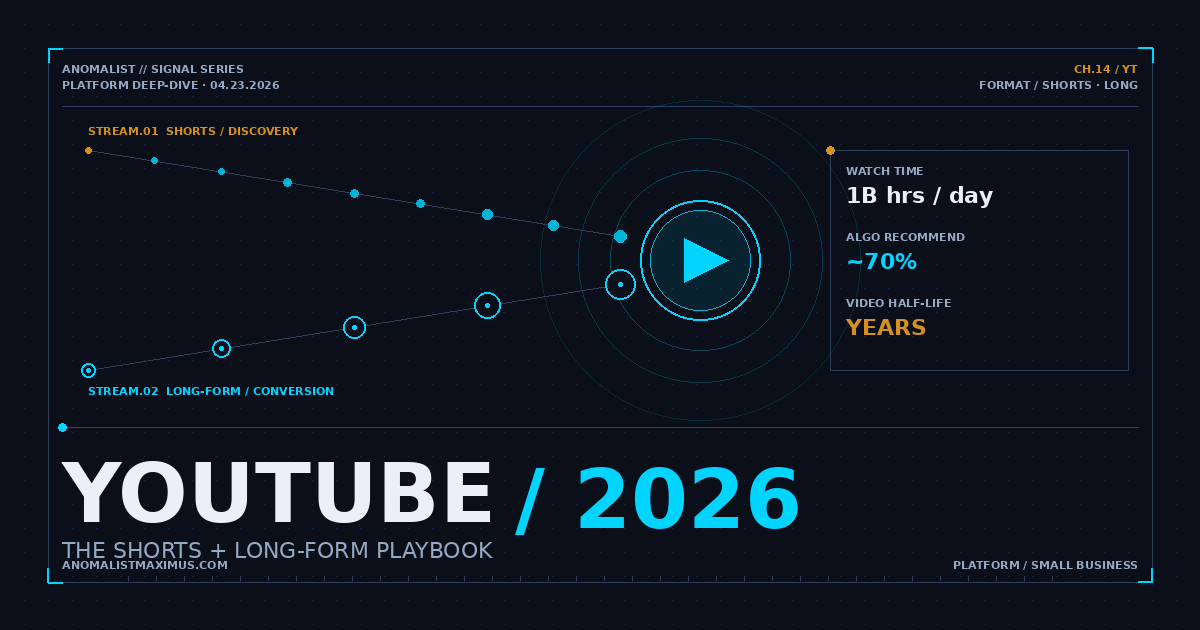
Here's the shift that matters: YouTube now processes over 1 billion hours of daily watch time, and roughly 70% of that comes through algorithmic recommendations rather than subscriptions. If your video answers a real question better than the competition, it gets surfaced. Forever. Not for 48 hours — forever.
A single 8-minute YouTube video explaining a common customer question can out-earn a year's worth of Instagram posts. Not because it's better content — because it's durable content.
The Two-Format Playbook
The small businesses winning on YouTube right now aren't picking between Shorts and long-form. They're running both, on purpose, with different jobs for each format.
Shorts: The Discovery Engine
YouTube Shorts in 2026 are where TikTok was in 2020 — easy reach for anyone willing to show up. The algorithm is still actively pushing Shorts to new viewers because YouTube wants the format to dominate. Use that.
Shorts are for getting discovered. Quick tips, myth-busters, behind-the-scenes, 30-second answers to common questions. Don't expect them to sell anything. Their only job is to put your face in front of people who've never heard of you — and push them toward your main channel.
Long-Form: The Conversion Engine
This is where the actual money is. A 6-12 minute video answering a real customer question — "How much does a kitchen remodel cost in 2026?" or "What does commercial auto insurance actually cover?" — ranks in search, plays to the end, and turns casual viewers into customers.
Long-form videos do three things Shorts can't: they build trust through depth, they rank in Google search results, and they keep people on your channel long enough that YouTube starts recommending you to similar viewers. This is the compounding layer.
Topics That Actually Work for Small Business
The single biggest reason small business channels fail is that they make videos about their business. Nobody searches for "ABC Insurance Agency walkthrough." They search for "how much life insurance do I actually need."
Make videos about the questions your customers ask you in person. Your best content is already living in your sales conversations, support emails, and consultation calls. Specifically:
- "How much does [thing] cost?" — The highest-intent searches on the internet. If your industry has any price confusion, own that video.
- "What's the difference between X and Y?" — Comparison content wins because it captures people in active decision mode.
- "Do I really need [service]?" — Addressing the objection before the sales call shortens every future sales call.
- "What should I know before [buying/hiring/starting]?" — Positions you as the expert before the competition even gets a chance to pitch.
- "Common mistakes in [your category]" — Always performs. Shows expertise without selling.
The Production Myth
Let me be clear: you don't need a studio. You don't need a crew. You don't need $4,000 of camera gear. Some of the highest-performing small business channels in 2026 are shot on a three-year-old iPhone in a well-lit room.
What you need is good audio, decent lighting, and a clear idea. In that order. Viewers will forgive a soft image. They won't forgive muffled audio or a rambling video with no point.
A $60 lavalier mic, a window behind the camera (not behind you), and a script outline. That's the whole setup. Everything beyond that is optional.
Practical Steps to Start Right
- List the 20 questions your customers ask most. Open a note. Write them down as they're actually asked, not how a marketer would phrase them. These are your video titles.
- Pick the highest-intent question first. Usually one about price, process, or comparison. That's your first long-form video.
- Write the video as a conversation. Imagine you're sitting across from one customer. Don't write a script — write an outline with the key points and talk.
- Shoot three Shorts from every long-form video. Your best 30-second clips become standalone Shorts. One long-form = one piece of conversion content plus three pieces of discovery content.
- Write real titles. Not "Welcome to my channel." Not "Episode 1." Actual search phrases: "How Much Does Commercial Auto Insurance Cost in Texas (2026)."
- Pin the best comment. After publishing, reply to every comment in the first 24 hours. YouTube's algorithm heavily weights early engagement.
- Publish once a week. Every week. For a year. This is the only part that's hard. The channels that win are the ones still uploading in month eleven when the first video finally breaks out.
Common Mistakes That Kill YouTube Growth
- Intro overkill. A 20-second logo animation before you say anything. Viewers leave. Get to the point in the first 10 seconds.
- Making every video about your business. Customers don't care about your company until they trust you. Trust comes from answering their questions first.
- Uploading without titles or thumbnails. The thumbnail is the video. Spend as much time on it as on the first minute of content.
- Quitting at month three. YouTube is a compound-interest platform. Nothing moves for 3-6 months, and then it moves a lot. The pattern that kills most small business content shows up here too.
- Treating Shorts like long-form, or vice versa. They have different jobs. Shorts discover. Long-form converts. Stop mixing the two.
The Bottom Line
YouTube rewards patience and depth — two things most small businesses aren't used to giving a marketing channel. But that's exactly why it's the most undervalued platform right now. The bar is low, the compound returns are real, and every video you upload this year is an asset that keeps working for you in 2027, 2028, and beyond.
Cut through the noise. Pick one customer question. Film a 6-minute answer on your phone. Clip three Shorts out of it. Upload everything. Repeat next week.
That's the whole playbook. And if you want to build a content system that does this consistently without eating your week, that's exactly what Maximus was built for.