Here's the uncomfortable truth about most AI-generated content: it's not bad. It's bland. And bland is worse than bad — bland gets posted, ignored, and quietly teaches your audience that your brand has nothing to say.
The fix isn't a better tool or a longer prompt. It's a five-minute edit pass on every AI draft before it leaves the queue. Not a rewrite — a surgical pass that strips the dead weight, swaps in real specifics, and puts the human voice back where it belongs.
Most small business owners skip this step because they think the AI is "done" when it hits paste-ready. The AI is never done. The AI is a first draft. Treat it that way and your content sounds like you. Treat it like a finished product and it sounds like everyone else using the same tool.
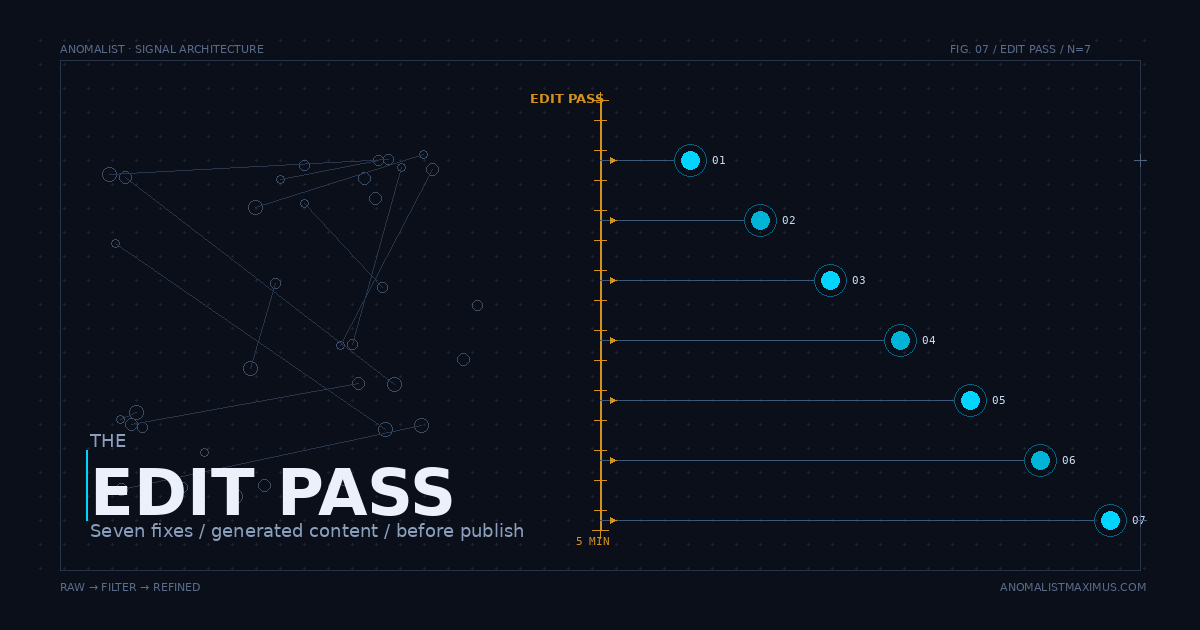
This post is the checklist. Seven specific fixes to run on the next AI-generated post sitting in your queue. Do them once and you'll feel the difference. Do them every time and your engagement curve quietly bends upward.
Why AI content needs a human pass — every time
Large language models are trained on roughly the entire publicly readable internet. That means they default to the average. The average phrase. The average opener. The average sign-off. The average call to action.
Average is exactly the problem.
A model that's read ten million blog posts will write the eleven-million-and-first the same way most of the previous ten million were written — because that's the median path. The fastest way to make AI content stop sounding like AI content is to find every place the model took the median path and replace it with something only you would have written.
That's what the edit pass does. It doesn't rewrite. It strips out the average.
Five minutes of editing is the difference between content that works for you and content that works against you. Skip it and you're paying for the worst version of your own brand.
The seven fixes — work top to bottom
1. Kill the opener if it starts with a generic stage-setter
If the first sentence is "In today's fast-paced world…", "More than ever before…", "In the digital age…", or "When it comes to…" — delete it. The post starts on sentence two. The AI added the throat-clearing because most of its training data did. Yours doesn't have to.
2. Replace one abstract example with one specific one
AI loves to write "a local business might consider posting more often." That's a placeholder. A specific version reads "a roofing company in Tulsa started posting daily job-site photos and booked four extra estimates in the first month." Even if the example is illustrative rather than literal, it lands. The brain reads specificity as authority. We dug into why this matters in our piece on writing hooks that stop the scroll — specifics are the texture of truth.
3. Cut two adjectives from any sentence with three
AI overwrites. It will produce "a powerful, comprehensive, and effective marketing strategy" when "a working marketing strategy" carries the same weight. Find any sentence with three modifiers stacked together and delete two. The remaining one will do more work.
4. Swap "utilize" for "use" — and every other corporate-speak twin
This is a global find-and-replace, every time. Some pairs worth cleaning: utilize → use. Leverage → use. Synergy → fit. Solutions → tools (or fixes). In order to → to. At this time → now. Optimal → best. Robust → strong. Holistic → whole. Drive results → work.
Corporate vocabulary is the strongest AI tell. Strip it.
5. Add one line that only your business would say
This is the most important fix. Somewhere in the post, drop one sentence that reveals a real opinion, observation, or experience. "We've stopped recommending Mondays for service businesses." "Half our clients are still posting from their personal phones, and it shows." "The cheapest insurance is almost never the right insurance."
That one line is your fingerprint. AI cannot write it because AI does not have your business. If you add nothing else from this list, add this one. We talk more about this in how to sound like yourself when AI writes for you.
6. Rewrite the call to action to match how you actually talk to customers
AI defaults to "Contact us today to learn more!" and "Don't hesitate to reach out!" These are the verbal equivalent of a limp handshake. Replace them with something direct: "Text us the address and we'll send a quote by tomorrow." "Email me and I'll ask the three questions that decide if we're a fit." "Book the call. If we're wrong for you, I'll tell you in the first ten minutes."
Specific CTAs convert. Generic ones decorate.
7. Read it out loud — and cut whatever you wouldn't say
This is the final pass and the only one that catches what the others miss. Read the whole post out loud, at normal pace. Anywhere your mouth hesitates, your voice flattens, or you'd skip a phrase if you were saying it to a customer — cut that sentence. Don't fix it. Just cut it.
If the post still makes sense after the cuts, it was carrying dead weight. If it stops making sense, restore only the missing logic — not the original phrasing.
Common mistakes that defeat the edit pass
- Editing inside the AI tool. Open the draft in a separate document. You'll be more honest when the model isn't watching.
- Editing right after generating. Wait at least an hour. Fresh eyes catch ten times more.
- Editing for length instead of voice. Length is rarely the problem. Genericness is.
- Trying to keep every word the AI wrote. The model is not precious about its prose, and neither should you be.
- Skipping the read-aloud. This single step catches more cringe than the other six combined.
The bottom line
AI tools are getting better fast — but "better" still means "trained on the median." Until your content gets a human pass that strips the median out, your brand sounds like every other business using the same tool. Five minutes of editing is the difference between AI content that earns trust and AI content that quietly erodes it.
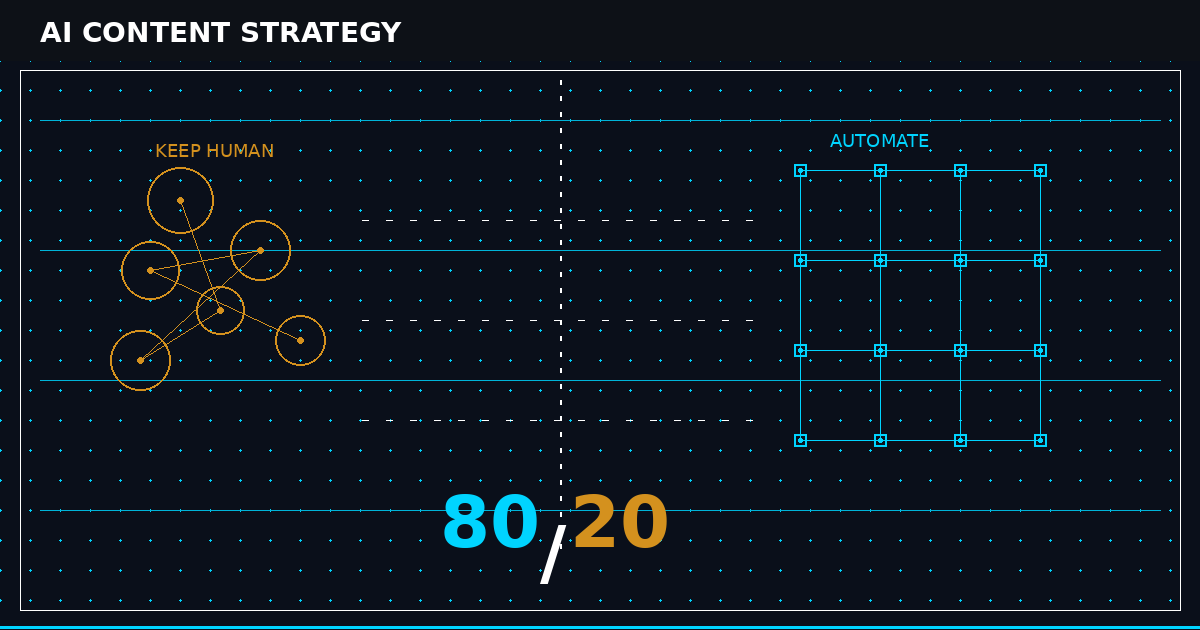
Run the seven fixes on the next post in your queue. Then the one after that. Two weeks in, the average sentence in your content will sound like a real person wrote it on purpose — which is the only version of AI content that ever actually works. For more on what to keep human and what to safely automate, see our 80/20 rule of AI content.