Most small business owners think running out of content ideas is a creativity problem. It's not. It's a sourcing problem. You don't need a better imagination — you need a better intake system.
Every business is sitting on more content material than it could ever post. Emails customers send you. Questions they ask on the phone. Reviews they leave. The small moments behind the counter that you've stopped noticing because they're normal to you. Every one of those is a post waiting to be written.
The hard part isn't generating ideas. It's catching them as they float past.
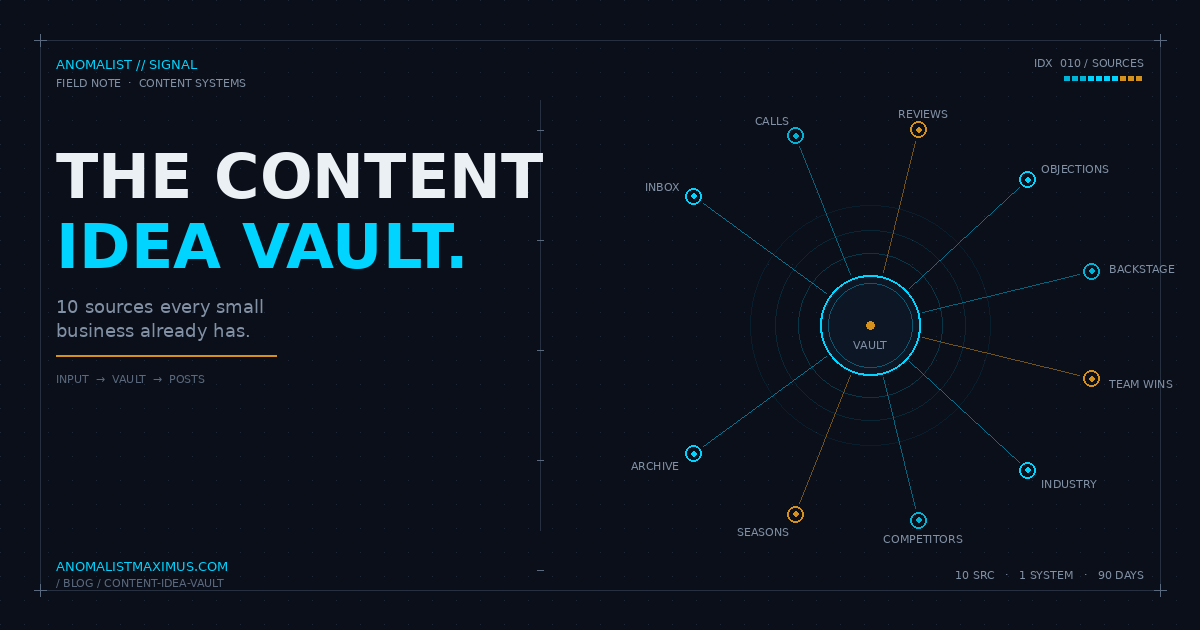
This is a vault. Ten sources you already have, sitting in your business right now, that can keep you posting for the next 90 days without inventing anything from scratch.
1. Your inbox
Open your email and read the last 20 customer messages. Not the receipts and confirmations — the real ones where someone asked a question or shared a problem.
Every recurring question is a post. Every misunderstanding is a post. Every "I didn't realize you also did..." is a post. If you got the question twice this month, you've got an audience for the answer.
2. The questions you answer on the phone
Most owners and front-desk staff answer the same five questions ten times a week. They become invisible because they're routine. They shouldn't be invisible — they should be your editorial calendar.
For one week, write down every question a customer asks before they buy. That list is your next month of content.
3. Reviews — yours and your competitors'
What people praise in your reviews is what you should be talking about. What they complain about in your competitor's reviews is positioning gold.
Read 20 reviews of the three businesses closest to you. Note what frustrates customers. Build a post around how your business does that thing differently. (We dug into this approach more in why your competitor's social media looks better than yours.)
4. The sales objection list
Every business has the same handful of objections that come up before a customer says yes. "It seems expensive." "I'm not sure I need it." "I tried something like this before and it didn't work."
Each objection is a post. You're not writing to argue with the objection — you're writing for the next person who has it but won't say it out loud.
5. Behind-the-scenes moments
The thing you do without thinking that took you a decade to learn. The way you set up a job site. The reason you ask a specific question during the consultation. The piece of equipment most customers don't even know exists.
You've stopped seeing this stuff because it's routine. Your customers have never seen it. Show them.
6. Your team's daily wins (and saves)
The save you made on the broken pipe at 9pm. The booking you rescheduled for the customer whose kid got sick. The custom order you put together because someone walked in with a weird request and you said yes.
These are the proof points that make your brand feel human. Most of them happen and disappear without anyone writing them down. Build a five-minute Friday ritual where someone on the team logs one moment from the week.
You can outsource the writing. You can't outsource the noticing.
7. Industry news, reframed
You don't need to write industry news — there are publications for that. You need to translate it.
When something happens in your industry — a regulation change, a new technology, a viral story — the post is "here's what this means for you, the customer." Two sentences of news, ten sentences of what it means. That's the format.
8. Your competitors' comment sections
Scroll their social posts. Read the comments. Pay attention to confused customers, to questions left hanging, to the ones complaining about something specific.
Those are your customers in two months if you address what's frustrating them. The content writes itself once you see the gap.
9. The patterns in your year
Every small business has seasons. Slow months. Rush months. Holidays where customers think about you and holidays where you have to remind them.
Map your year. Mark the predictable spikes and dips. Plan content into the dips so you're top of mind when they're ready to buy in the spike. Your fitness studio in January writes differently than your fitness studio in October. Both posts already exist in the calendar — you just have to write them on time.
10. The old content that already worked
Most small businesses post once and move on. That's a waste. If a post got real engagement six months ago, that idea has a longer shelf life. Repackage it. Update it. Run it again from a different angle.
Open your analytics. Sort by engagement. Your top three posts from the last year contain three new posts. (For more on this, we wrote about the content repurposing flywheel.)
How to actually use the vault
A list of sources doesn't help if it lives in your head. Build the capture system:
- One inbox for ideas. A note on your phone, a single doc, a Trello board — pick one. When something happens that's worth a post, it goes there. No second location.
- A 10-minute Sunday review. Once a week, you or whoever runs your content opens the inbox and pulls out enough ideas for the week ahead.
- One source per day. Don't try to mine all ten at once. Monday is reviews. Tuesday is the phone-call list. Wednesday is behind-the-scenes. Rotate. The vault refills as you work the business.
- Stop deleting. Save the customer emails. Screenshot the funny reviews. Keep the photos you take on the job. You're not building a museum — you're building raw material.
What kills the vault
- Trying to be original. Originality is overrated. Your customers don't want unique — they want clear, helpful, and timely. The 50th post about "why we use this specific tool" is more useful than yet another generic motivational quote.
- Outsourcing the noticing. You can outsource the writing. You can't outsource the noticing. Whoever interacts with customers has to be the one logging the source material. Otherwise you end up with generic content because you're working from generic prompts.
- Saving everything for the perfect post. Stop holding ideas back for the perfect version. Post the rough one this week. The perfect version was never going to get written anyway.
- Mining once and quitting. The vault isn't a one-time exercise. It's a habit. Five minutes a day beats five hours once a quarter.
The bottom line
Running out of content ideas is almost never the real problem. The real problem is that the ideas show up in the middle of your day and you don't catch them.
Build the vault. Watch what comes through your business this week. Write it down. The next 90 days of content is already inside your business — you just have to start looking at it as content instead of as work.
Cut through the noise. The well isn't dry. You just haven't been collecting the water.