Walk past any independent restaurant on a Tuesday night and you'll see the same thing: half-empty dining room, owner staring at the door, hostess scrolling her phone. Then walk past the spot two blocks over with a line out the door. Same rent. Same neighborhood. Maybe even the same food quality.
The difference is almost never the menu. It's that one of them figured out how social media actually fills seats — and the other one is still posting a photo of their lasagna once a month and wondering why it's not working.
Here's the uncomfortable truth: in 2026, your restaurant's social presence is your front window. If it's dim, dusty, or stuck in 2019, you're invisible to everyone under 45 making dinner plans on their phone. Let me walk you through what's actually working right now for independent restaurants — and what's just noise.
Why Restaurants Get Social Media Wrong
Most restaurant owners I talk to think of social media like a flyer. Snap a photo of the special. Add a caption. Post it. Done. Move on.
That's not marketing. That's a digital chalkboard. And chalkboards don't bring people in — they remind people who already walked past.
Restaurants are uniquely positioned to win on social. You have something most small businesses don't: a constant, daily, visual product. Every plate is a shot. Every service is a story. Every regular is a testimonial. The raw material is incredible. The execution is what fails.
If your social posts could be swapped with the place down the street and nobody would notice, you're not marketing — you're filling space.
The restaurants winning right now aren't doing more. They're doing different. They've stopped posting "what" they served and started posting who they are, why this place exists, and what tonight will feel like.
The Five Platforms That Actually Matter
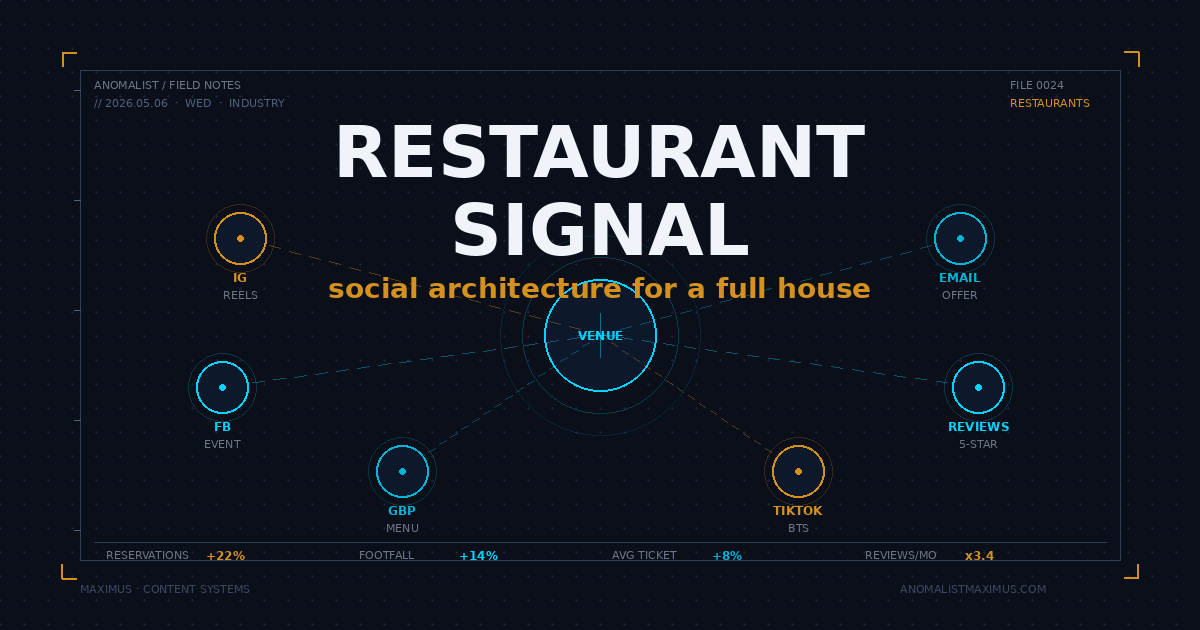
Forget trying to be everywhere. In 2026, restaurants need to be excellent on five places, in this order of priority. Pick the top three for your operation and ignore the rest until those are running clean.
1. Google Business Profile (Yes, It's Social)
This is the one most owners forget is even a channel. When someone Googles "best Italian near me" at 6:47 PM on a Friday, your Google Business Profile is the deciding factor between them sitting at your bar in 20 minutes or somebody else's. It's not optional. It's the front door.
What to do: post weekly Google updates with photos of dishes, events, and happy hours. Respond to every review, good and bad, within 48 hours. Keep your hours, menu link, and photos current — outdated info is the #1 reason Google demotes you in the local 3-pack. We've covered the broader ranking dynamics in our local SEO guide if you want to go deeper.
2. Instagram (Reels, Not Just Photos)
Instagram is still the dominant restaurant platform, but the rules changed. Static photos of food don't perform anymore. Reels do — and specifically, short reels with motion: the pour, the toss, the slice, the plate-up. Cinematic 8-to-15 second clips. Sound on. Captions short.
Your Instagram grid is your menu. Your Reels are your invitation.
If you're posting only static plate shots in 2026, you're showing up at a costume party in a suit. Everyone else is in motion.
3. TikTok (Especially If You Want Anyone Under 35)
TikTok is no longer optional for restaurants targeting Gen Z and younger millennials. The discovery engine is unmatched — a single 22-second video showing your line cook flipping a burger can put 4,000 people in your DMs by Saturday. You don't need to dance. You need to be authentic, fast, and a little weird.
Behind-the-scenes is the cheat code: prep, opening checklist, the chef yelling at someone, the regular who comes in every Tuesday for 18 years. Show the reality. People follow people, not menus.
4. Facebook (For Events, Reservations, and the Over-40 Crowd)
Facebook isn't dead — it just shifted. For restaurants, Facebook is now primarily an event and community platform. Wine dinners. Brunch announcements. Live music nights. Mother's Day reservations. Holiday menus. Anything with a date and a "save this" hook.
Your over-40 customers — the ones with disposable income and habit-driven dining — still live there. Don't write them off because TikTok exists. We've broken down the Facebook angle in detail in our Facebook playbook for small business.
5. Email (The Quiet Killer)
Not technically social, but I'm including it because it's the most underused channel in restaurant marketing and it consistently outperforms paid ads. A simple monthly email to your customer list — new menu, upcoming events, a story about a supplier — drives more reservations per dollar than any other channel. Build the list now. Use it every month. Don't sell. Tell.
The Content Types That Fill Seats
Posting frequency without content quality is just noise at higher volume. These are the seven content types that consistently move restaurants. Rotate through them. Don't get stuck in one lane.
Plate Cinematics
Short, beautiful, motion-rich clips of food being made or finished. The pour of olive oil. The cheese pull. The flame. 6-15 seconds. Music underneath. No corny voice-over. This is your "scroll-stopper" content — it doesn't need to convert, it just needs to make someone pause.
The Story Behind the Dish
Why does this dish exist on your menu? Whose grandmother made it? What's the supplier's name? What's the dish that almost didn't make it onto the menu? Restaurants are stories told through food. Tell the stories.
The Owner / Chef on Camera
People follow people. Two of every ten posts should have a human in them — owner, chef, bartender, anyone with a face and a personality. Not a corporate-headshot vibe. Real. Slightly tired. Mid-service. Holding a knife.
The Regular
The customer who comes every week. The couple who got engaged at table 12. The local sports team that piles in after games. Restaurants are communities. Show the community. With permission, always.
Behind-the-Scenes Operations
Prep, deliveries, the morning the fish guy comes in, the mise en place lined up before service. People are weirdly fascinated by this stuff. Use it.
Specials and Limited Drops
The Wednesday burger night. The bourbon flight. The specials board. Anything with scarcity or a deadline. Time-bound posts get acted on; evergreen posts get scrolled past.
Reviews and Social Proof (Done Right)
Don't post a screenshot of a 5-star review with a thumbs-up emoji. Pull the one specific line that matters and pair it with a photo of the dish they raved about. Make it a story, not a brag.
How Often to Post (And Why More Isn't Better)
This is where most restaurant owners panic and quit. They've heard "post 7 times a week" and the math collapses on a Tuesday morning when there are 80 covers to prep and a fryer that's broken.
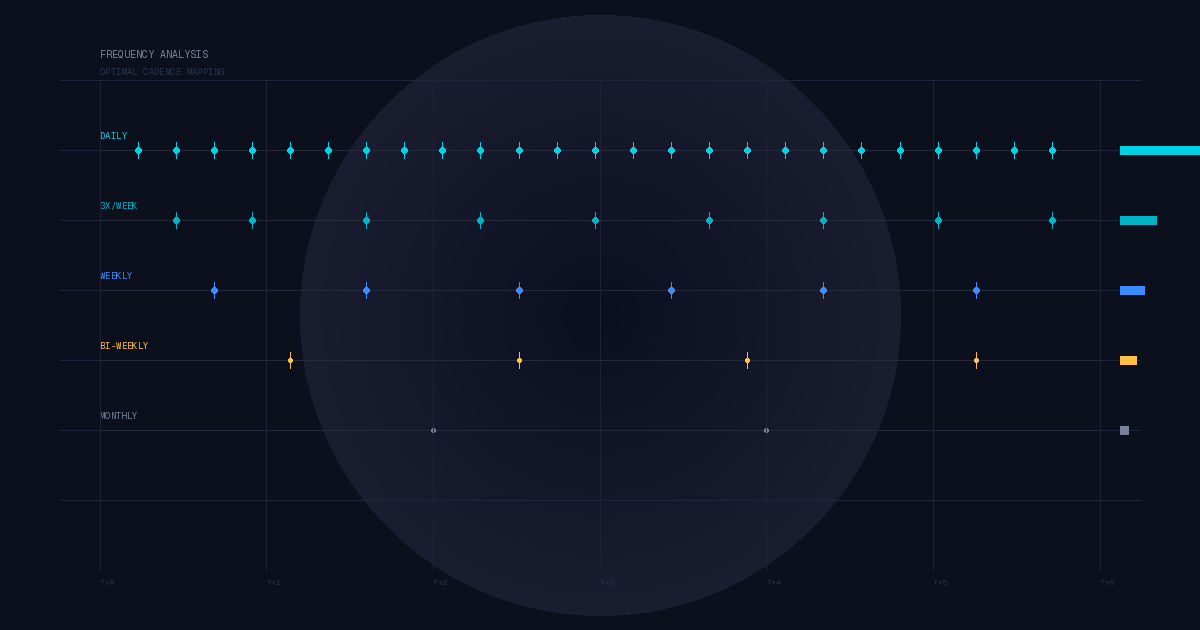
Here's the realistic 2026 cadence for an independent restaurant. Match your operation, not someone else's:
- Instagram: 4-5 posts per week. Mix of Reels (3) and feed posts (1-2). Stories daily — they take 12 seconds and they're free reach.
- Google Business Profile: 1-2 posts per week. Photos plus event/special updates.
- TikTok: 3-4 posts per week if you're committing. Less than that and the algorithm forgets you exist. If you can't commit, skip it for now.
- Facebook: 2-3 posts per week. Event-heavy. Cross-post from Instagram for efficiency, but don't lazy-cross-post — captions need to fit Facebook readers.
- Email: 1 monthly newsletter, plus event announcements as they come.
That's roughly 12-15 pieces of content per week across all channels. Sounds like a lot. It's not, when you understand that one shoot session can produce a week of content if you plan it right. We've written more on multiplying one piece of content into many in our content repurposing flywheel post — the same logic absolutely applies to restaurant content. One 30-minute Saturday shoot of plates, prep, and one chef interview can fill an entire week.
For a more general primer on cadence, see our breakdown of how often a business should post on social media.
The 30-Day Restaurant Social Reset
If your restaurant's social is currently a mess — outdated photos, ghost-town engagement, sporadic posting — here's the 30-day reset. Run it as a project. Then keep going.
- Days 1-3: Audit and clean up. Update Google Business Profile hours, menu link, and photos. Replace any photos older than 12 months. Remove any that don't represent your current product.
- Days 4-5: Pick three platforms. Based on your customer base. Most restaurants: Instagram + Google + Facebook. Younger crowd: swap Facebook for TikTok.
- Days 6-7: Set up a content schedule. Block 30-45 minutes on Saturday morning for a weekly content shoot. Put it on the calendar like a delivery.
- Days 8-10: Run your first shoot. Five plates, three behind-the-scenes clips, one chef-on-camera moment. That's your week of content.
- Days 11-21: Post on the cadence above. Don't wait for perfect. Don't over-edit. Authenticity beats polish.
- Day 22: Reply to everything. Comments, DMs, reviews. All of it. Engagement signals the algorithm that real humans are at this account.
- Days 23-25: Build your email list. QR code on the table tents. Sign-up form on the website. Train the host to ask. "Get our monthly menu drops" is enough of a hook.
- Days 26-28: Run one paid promotion. $50 boost on a Reel or a Facebook event post. Targeted to a 5-mile radius. Watch what happens. This is your data.
- Day 29: Review the metrics. Reach, follower change, profile visits, reservation/inquiry uplift. Note what worked.
- Day 30: Build month two's plan. Same cadence, two new content angles tested.
Mistakes That Will Empty Your Dining Room
The traps independent restaurants fall into are remarkably consistent. Avoid these:
- Posting only when you have a slow week. The algorithm doesn't reward panic. It rewards consistency. Posting only when reservations are down trains the platform that you're a sometimes-account.
- Stock-photo plates. The internet can smell stock food photography from a mile away. Use your phone. Use your real food. Imperfect beats sterile every time.
- Auto-cross-posting from Instagram to TikTok. The Instagram watermark on your TikTok will get you buried in the algorithm. Edit each piece for the platform.
- Ignoring negative reviews. Every unanswered 1-star review is a future customer choosing the place down the street. Respond calmly, briefly, in public. Take the conversation offline. Never argue.
- Posting menu screenshots. A photo of a printed menu is not content. It's a document. People don't share documents.
- Forgetting captions. The hook is in the first line. "Tonight's special" is not a hook. "If you've ever wondered what 18 hours of slow-braising smells like at 3 PM, come in tonight" — that's a hook.
- Going dark for two weeks at a time. Restaurant social is a habit, not a project. Two weeks of silence and your reach craters.
- Treating staff like extras. Your team is your secret weapon. Feature them. Pay them in dignity, not just exposure.
The Bottom Line
Restaurant social media isn't about being a content creator. It's about turning the natural drama of your kitchen and dining room into invitations. The food is already there. The stories are already there. The personalities are already there. The job is to point a camera, write a sharp line, and post on a schedule you can keep.
The independents winning right now aren't running paid ads at the level of the chains. They're winning by showing up with character, consistently, on the platforms their customers actually use. It's not glamorous. It's not complicated. But it does require commitment — and most restaurants quit before the algorithm even notices them.
Don't be that restaurant. Pick three platforms. Build the cadence. Show the realness. Fill the room.